Turkey sets a new trap in the Aegean
Διαβάζεται σε 4'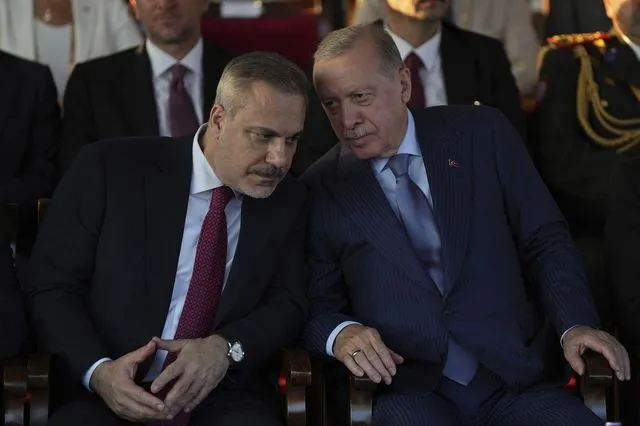
Fidan rushed yesterday to preannounce the Mitsotakis–Erdoğan meeting to take place in February, while also speaking of a permanent solution “primarily to the Aegean issue.” Athens responds that “there is only one difference with Turkey”: the delimitation of the Exclusive Economic Zone (EEZ).
- 16 Ιανουαρίου 2026 10:09
Athens is being called upon to avoid the new traps that Turkey is attempting to set ahead of the next meeting between Kyriakos Mitsotakis and Recep Tayyip Erdoğan.
It is recalled that after a long period of “freeze” in Greek–Turkish dialogue, the two sides have agreed to hold the Greece–Turkey High-Level Cooperation Council (HLCC) within the first quarter of 2026.
The next Greece–Turkey HLCC is set to take place in Ankara, and within its framework the Greek prime minister will meet once again with the Turkish president. However, it will occur in a very different international environment compared to December 2023, when the previous HLCC session between Greece and Turkey was held in Athens.
Not only because Ankara has since gradually returned to a policy of provocations and has made it clear that it will continue to place revisionist claims on the table, but also because the “bad example” set by U.S. President Donald Trump—who has treated international law and the inviolability of borders with contempt—could whet the appetite of regional would-be “players.”
No room for third parties in bilateral dialogue
It is also noted that the U.S. ambassador to Turkey, Tom Barrack, has stated that the Trump administration wants to act as a “bridge” in Greek–Turkish relations so that “the bitterness of the past can be overcome,” as he put it. Of course, Washington’s desire to bring Greece and Turkey to a negotiating table with itself in the role of arbitrator—while eyeing the energy resources of the Eastern Mediterranean—is nothing new.
Athens denied, however, that any “third-party initiative” has been undertaken or that such a proposal has reached the Greek side. “We handle issues with Turkey bilaterally, as provided for by international law,” the Foreign Ministry spokesperson, Lana Zochiou, had stated. Former foreign minister Dora Bakoyannis was particularly vivid: Greece and Turkey do not need third parties in order to talk.
Yet even in a bilateral dialogue, Ankara continues to try to broaden the range of issues for discussion, pressing for a package solution covering all the matters it claims exist between Greece and Turkey. As for international law? It is considered banal in the Trump era…
Fidan’s statements and Athens’ clear response
Against this backdrop, Athens listened very carefully to yesterday’s statement by Turkey’s foreign minister, Hakan Fidan, who not only rushed to preannounce that the HLCC (and thus the Mitsotakis–Erdoğan meeting) would take place in February, but also stated that “the Aegean problem can be permanently resolved.” He also reiterated Ankara’s long-standing positions on the continental shelf issue. Of course, the Turkish side also raises issues of “grey zones” and the demilitarization of Aegean islands.
Asked whether the Greece–Turkey HLCC would indeed take place in February, government spokesperson Pavlos Marinakis confirmed that this is a possible scenario, but clarified that no date has yet been finalized, as both sides’ teams are still searching for one. “When such finalization occurs, there will obviously be a relevant announcement from both sides,” he added pointedly.
Regarding the agenda, Mr. Marinakis stressed: “Consistently and without ever any deviation, we insist that there is only one difference separating us from Turkey: the delimitation of the EEZ and the continental shelf, under and on the basis of international law—and no other.”
He noted that it is also beneficial for issues of policy or a “positive” agenda—the so-called issues of “low politics”—to be placed on the dialogue table.
Meetings of the Greek and Turkish diplomatic delegations for Political Dialogue and the Positive Agenda are continuing:
On Tuesday, January 20, within the framework of the 5th meeting of the Political Dialogue process between the foreign ministries of Greece and Turkey, talks will take place in Athens between Deputy Foreign Minister Alexandra Papadopoulou and Turkey’s Deputy Foreign Minister Mehmet Kemal Bozay. Meanwhile, on Wednesday, January 21, the 9th round of Greek–Turkish talks on the Positive Agenda will be held in Athens between Deputy Foreign Minister Haris Theocharis and Mr. Bozay.