Fight between meteorologists – Thodoris Kolydas’ analysis about snow in Athens
Διαβάζεται σε 7'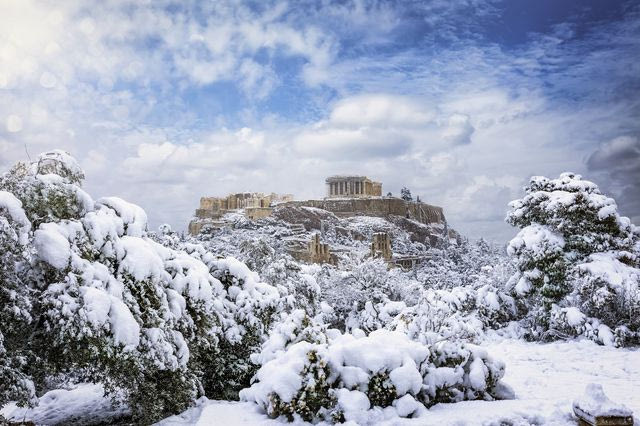
Another cold spell is about to arrive on Saturday, with rain and snow expected on Tuesday and Wednesday. But that is exactly what we were told last week as well — a week that ultimately turned out sunny. So what should we actually expect?
- 16 Ιανουαρίου 2026 15:04
Some had promised snowfall in cities at the beginning of last week, yet in the end there was no need even to switch on the water heater, as the solar heater did the job thanks to the sunshine.
In the meantime, a dispute also emerged among meteorologists — with some not “seeing” any snow at all, while others insisted it was coming — as often happens in any science that focuses on forecasting dynamic phenomena (such as seismology).
Now we are once again being informed of a drop in temperatures from the weekend, and once again some meteorologists are talking about snowfall during the coming week. To put your mind at ease, we contacted the ever-calm and reliable Thodoris Kolydas, Director of the Hydrometeorology and Natural Disasters Sector at the Assist laboratory of Democritus University of Thrace, to find out what lies ahead.
We also took the opportunity to clear up some questions we had from last week.
Why meteorologists disagree about snow
So why do meteorologists disagree when it comes to snowfall, given that forecasting a cold spell and its intensity is inherently complex — as Mr Kolydas has thoroughly explained on his website? (In his article on snowfall, the respected meteorologist also offers guidance on how we can find “a great deal of weather information, and especially snow-related data,” on our own.)
“Snow is an extremely difficult issue, regardless,” he notes.
“If you get it wrong once with rain, you can get it wrong ten times with snow, because there are many parameters involved. It is a much more complex element, and in Greece there is not even systematic measurement of snowfall.”
“In general, the weather cannot be ‘read’ from a single map, nor from just one model run. It is interpreted through convergence, repetition of signals, and their physical consistency over time. Some meteorologists also have their own forecasting models, which they trust, and they may believe that if they look into it more deeply, they will find additional evidence.
“However, all models show significant deviations. That is why meteorologists must first observe the main wave — whether it will arrive, whether it will bring cold air, or, in any case, what exactly will arrive — before making any statements.”
“To make a forecast, you need the proper tools. Then you have to assess measurements and models together, to understand which scenario is more likely. If someone relies solely on models that are not being fed with new data, the conclusions will be wrong.”
No matter how good those models may be.
“Even if it’s the European model, which is the best. When measurements are not carried out properly, both the models and the meteorologists are misled.”
In just a few moments, we will also explain why measurements are not being conducted as they should be.
“If a meteorologist is cautious, they will suggest waiting a little longer. If someone believes they have the best model at their disposal, they simply report what that model is showing at that particular moment. But that is not correct, because if the model has not been fed with the appropriate data, it will produce the wrong conclusion.”
Budget cuts at the Hellenic National Meteorological Service do not help
Some meteorologists were predicting snow down to sea level in Attica at the beginning of last week, while others — including the Hellenic National Meteorological Service (HNMS) — were dismissing that scenario.
“Five to six days in advance, I had said that the main feature would be the cold and that we could not talk about snowfall,” Mr Kolydas recalls. “As the days went by, on Sunday — the eve of the supposed arrival of the cold wave — I intervened at the HNMS to request continuous atmospheric soundings with radiosondes in Athens, Thessaloniki, and Heraklion. That was done in the evening, and I thanked them for it.”
By way of explanation, radiosondes are meteorological instruments launched into the atmosphere with balloons, providing data that complement information from radar and satellites.
According to information from NEWS 24/7, due to budget cuts at the HNMS, only half of the required soundings are currently being carried out. Clearly, this means that forecasting models and scientists are not equipped with the proper tools for predicting severe weather events.
What emerged from the continuous measurements taken that Sunday, combined with model data?
“That nothing significant would happen — that snow would fall only in mountainous areas,” as indeed proved to be the case.
The “ego” of meteorologists
What happened on Monday and Tuesday in Attica — when some were promising snow but sunshine ultimately prevailed — was also reflected in the HNMS weather bulletin. However, it did not receive the attention it deserved, partly because — if I may be allowed to say so — the Service continues to communicate in the language and style of another era and does not make proper use of modern communication tools, such as social media accounts.
As a result, the confusion caused by disagreements among meteorologists persisted, with some continuing to insist on snowfall.
“Some may have stuck to an incorrect forecast out of ego. They had already been exposed and, instead of dialing it back and saying that ‘model output is not gospel,’ given that we are dealing with dynamic phenomena, they remained inflexible. That’s where the damage is done.
“If a meteorologist examines HNMS data, they will realise they made a mistake one or two days earlier. At that point, they need to revise their position.”
“If we want fewer ‘off-key notes,’ it is not enough to criticise them. We must strengthen the conductor — namely, the HNMS.”
According to sources, the Hellenic National Meteorological Service is set to return to the Ministry of Defence (the justification being that it concerns “national defence” — comments are yours), whereas three years ago it had been decided that it would move to the Ministry of Climate Crisis and Civil Protection.
Will there be snow next week?
Leaving the past behind, let us look at what lies ahead, as some meteorologists have once again spoken of snow in Attica.
Mr Kolydas explains on his blog that:
“Winter is not over. We are essentially halfway through it, with atmospheric circulation reminding us that January and February remain the quintessential months for organised winter episodes.
“The coming days do not point to a transitional period, but to wintry conditions, where atmospheric physics once again takes centre stage.”
Speaking to NEWS 24/7, he adds:
“The good news is that while the Siberian cyclone is indeed moving south, its air masses will collide with warmer masses over the Mediterranean. As a result, we will see some snowfall, but only in mountainous and semi-mountainous areas.
“It is a typical cold spell, without major extremes, mainly at higher elevations, and without causing serious problems.
“It will last almost the entire coming week, with some fluctuations. The most intense phenomena are expected on Tuesday and Wednesday. After that, there are indications of other developments from the following Sunday onwards, but we will look at those when the time comes.”