Mitsotakis seeks new measures, but with European backing
Διαβάζεται σε 5'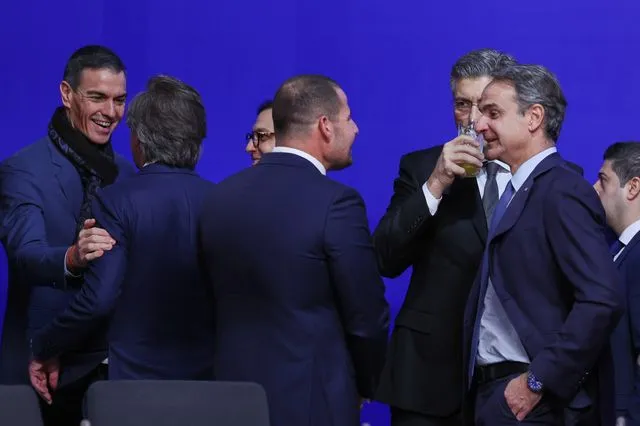
The war in Iran does not appear likely to end soon, and Athens is sending a message to Brussels about the need for European interventions as well, as additional support measures will also be required.
- 16 Μαρτίου 2026 10:24
From the moment it became apparent that the US–Israel attack on Iran would not have the immediate result that Donald Trump had expected, officials in Athens began examining the possible economic consequences and planning potential new support measures for households and businesses.
The issue, however, is that without a coordinated European strategy — or at least tolerance from Brussels for “generous” moves by member states — the government cannot, for example, reintroduce the fuel pass, which was first implemented in April 2022 to offset increases in fuel prices caused by Russia’s invasion of Ukraine.
As long as the war in Iran drags on, there is also the risk that fiscal margins could be exhausted. The government insists that the Greek economy has resilience and that the budget includes scenarios for external crises. However, Brent crude oil is already repeatedly exceeding the alarm threshold set by the government at $100 per barrel for the adoption of fuel measures. On Friday it reached $103 per barrel, and when international markets reopened on Monday it rose to $104. This happened despite the decision by 32 member countries of the International Energy Agency (IEA) to gradually release 400 million barrels from their strategic reserves.
The European Union summit this Thursday, March 19, will therefore be crucial. The president of the European Council, António Costa, called on the 27 EU leaders to identify the appropriate tools for a “timely, coordinated and effective response” to the consequences of escalation in the Middle East, particularly regarding energy prices. Greece, through Prime Minister Kyriakos Mitsotakis and the Minister of Finance and Eurogroup president Kyriakos Pierrakakis, will advocate the need for European initiatives.
Mitsotakis’ instructions to Pierrakakis
“The direction I have given to the finance minister is that in the worst-case scenario we will need not only a national but also a European response,” Mr Mitsotakis said during a pre-conference event of New Democracy in Larissa on Saturday. “I believe that our voice is now being heard in Europe and I hope that in this undesirable scenario Europe will rise to the occasion,” the prime minister added.
He nevertheless assured that the Greek government has the ability to support society with targeted measures for as long as the crisis lasts using national resources. But he stressed that where necessary, European initiatives should also be taken.
Mr Mitsotakis in any case announced imminent announcements to support Greece’s energy-intensive industry, as other member states are already doing.
In his regular Sunday post, the prime minister also referred to the imposition of a cap on profit margins both in fuels — with special provisions for the islands — and on 61 products in supermarkets.
“Obviously, no country can deal with an international price crisis on its own. But it can set rules in the market so that the pressure that already exists does not turn into an unjustified burden for citizens,” he noted.
He reiterated that the government will act accordingly “when there is a clearer picture regarding the evolution of the crisis and of course based on the resilience of the economy.” He also said: “The fiscal responsibility of recent years gives us room today to intervene, with the hope that we will soon move towards de-escalation.”
The difficult decision on Aspides
Athens, meanwhile, will soon have to take a difficult decision regarding the possibility of expanding the “Aspides” mission to the Strait of Hormuz. According to the Financial Times, this is expected to be discussed today by EU foreign ministers at the Foreign Affairs Council.
It is recalled that French President Emmanuel Macron had referred to a new operation by European countries in the Strait of Hormuz during joint statements with Mr Mitsotakis and the President of Cyprus, Nikos Christodoulides, during their joint visit to Cyprus last Monday.
Government officials later clarified that there is no intention of sending Greek ships to the Strait of Hormuz, noting that the Aspides mission has a specific mandate and limited geographical scope.
The “Aspides” mission, in which Greece, France and Italy currently participate with one ship each, so far concerns providing protection from Houthi attacks on commercial vessels in the Bab el-Mandeb strait, off the coast of Yemen.
Meanwhile, Donald Trump on Saturday called on China, France, Japan, South Korea, the United Kingdom and other countries affected by the closure of the Strait of Hormuz to send warships to help keep this critical passage open.
It is noted that Defence Minister Nikos Dendias, when asked on March 4 about the possibility of Greece participating in a European operation in the Strait of Hormuz or in a NATO multinational force against Iran, stated: “I cannot rule anything out, but I also cannot agree to anything.” He also said: “If there is a European operation we will examine it, but we will weigh the risk and the danger for the Navy.” He further clarified that: “The safety of our personnel always comes first.”