Macron visit to Athens: Defence, economy and EU in focus
Διαβάζεται σε 3'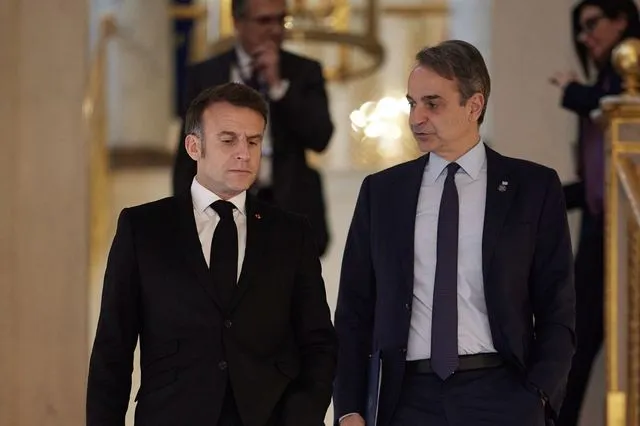
How the Greek government views the upcoming official visit of French President Emmanuel Macron to Greece.
- 19 Απριλίου 2026 13:36
At a time of heightened geopolitical uncertainty, with Europe seeking a new direction both in strengthening its competitiveness and in shaping a more coherent defence policy complementary to NATO, the visit of French President Emmanuel Macron to Athens on April 24–25 takes on particular significance.
As highlighted in an informal briefing by the Greek government, it “constitutes a major step in deepening an already close relationship, into which new areas of cooperation will be incorporated, reflecting the increased demands of the current circumstances, while placing Greek-French cooperation at the core of discussions on the future of Europe and the European defence and security framework.”
The visit of the French President will seal the renewal of the Greek-French strategic partnership agreement on security and defence, while also paving the way for further deepening of cooperation in areas such as the economy, civil protection and innovation.
It is recalled that the initial strategic partnership agreement on defence and security, signed in September 2021 at the Élysée Palace, served as a precursor to the broader European discussion on strengthening common defence and the strategic autonomy of the European Union, in complementarity with NATO.
The Prime Minister and the President of France are among the few European leaders who have consistently and early raised this issue at a European level. The need was underlined by both leaders during their recent visit to Cyprus, where they highlighted the security dimension within the European framework—while also underscoring the upgraded role of Greek-French relations as a pillar of stability in the Eastern Mediterranean.
Maritime security is also expected to feature high on the agenda, with particular focus on the Strait of Hormuz. Unlike other European countries, Greece does not limit itself to theoretical positions: it actively participates in the European operation EUNAVFOR ASPIDES, reaffirming its role as a global maritime power with a strong interest and sensitivity in matters of maritime security.
Moreover, the Prime Minister has set maritime security as a top priority, having addressed the issue during the central event of Greece’s Presidency of the UN Security Council last May.
At the same time, the renewal of the strategic partnership agreement for a five-year period, with a provision for automatic extension indefinitely, further strengthens the already close framework of cooperation.
The signing of new agreements is expected to expand the bilateral agenda. From defence and foreign policy to the economy, innovation, civil protection, as well as shared values, the protection of international law and the principles of multilateralism in international relations and the role of the United Nations, Greek-French relations are entering a phase of further institutionalisation and deepening. They are acquiring the characteristics of a cohesive, multi-level partnership with duration and depth.
Particular emphasis is also placed on the protection of minors online, with Greece and France among the first EU countries promoting initiatives to regulate the use of social media by minors. Both countries are at the forefront of shaping a European regulatory framework.