Delphi: Journey to the navel of the Earth
Διαβάζεται σε 4'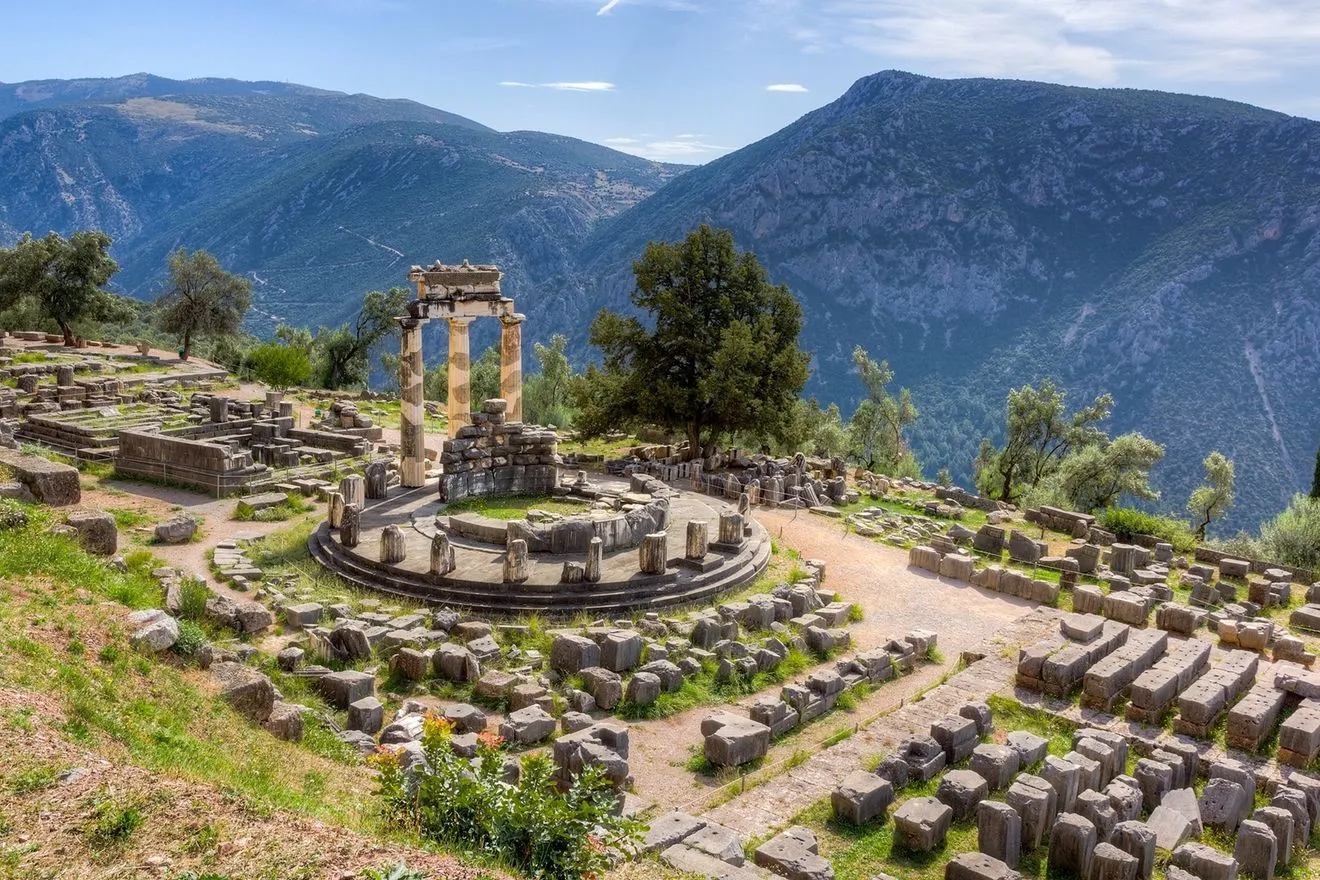
- 24 Μαρτίου 2026 10:31
As Delphi prepares to welcome once again the Delphi Economic Forum XI (April 22–25, 2026), contemporary global thought symbolically returns to the place where, for thousands of years, answers about the future were sought. Among international leaders, analysts and visionaries, the visitor has the opportunity to experience something deeper: a journey to the “navel of the Earth”, where myth, history and nature coexist inseparably.
A world heritage monument, the supremacy of nature and an oracle. In Delphi, you do not simply visit an archaeological site — you encounter the gods. The Delphic landscape, recognised by UNESCO as early as 1972, unfolds as an experience that transcends image and word. The myth surrounding the ancient sacred site.
According to mythology, this is where the two eagles sent by Zeus from the ends of the world met to determine its centre. Here, too, Apollo founded his sanctuary after defeating the dragon Python, establishing the most renowned oracle of antiquity. From the 6th to the 4th century BC, Delphi was a spiritual and religious centre, with the Pythia delivering prophecies that shaped the course of cities and individuals.
The journey begins with the landscape itself. At the foot of Mount Parnassus, between the imposing Phaedriades cliffs, stretches an endless olive grove reaching down to Kirra. The “Delphic landscape” is at once gentle and wild, welcoming and mystical — as if it obeys an invisible music that permeates the visitor.
Ascending the Sacred Way, the traveller follows in the footsteps of ancient pilgrims. Among treasuries, offerings and monuments, one reaches the Temple of Apollo, where in the adyton the Pythia delivered her oracles. Slightly higher, the theatre and the stadium complete the image of a place where religion, art and athletics coexisted harmoniously.
In the shadow of the rocks, the Castalian Spring recalls the ritual of purification. Here, body and spirit were cleansed before every oracle. Its waters, associated with the nymph Castalia, continue to symbolise the source of inspiration and quest.
The archaeological site is framed by monuments that narrate the full story of antiquity: the Sanctuary of Athena Pronaia with its mysterious Tholos, the gymnasium, the palaestra, the baths. Each point is a fragment of a civilisation that continues to influence the modern world.
At the Archaeological Museum of Delphi, the visitor comes face to face with the famous Charioteer, one of the most iconic works of ancient Greek art. The museum’s halls illuminate the daily life, faith and aesthetics of a world that has never ceased to inspire.
Today, the spiritual tradition continues at the European Cultural Centre of Delphi, which hosts international meetings, conferences and artistic events, just like the Delphi Economic Forum, bringing Delphi back to the centre of global dialogue. At the same time, the revival of the Delphic Festivals by Angelos Sikelianos and Eva Palmer serves as a reminder that Delphi is not only the past, but also a lasting proposition for the future: a meeting place of cultures, ideas and people.
For those wishing to explore beyond the familiar, the “hidden treasures” of the region offer unique experiences: the mystical Corycian Cave, the paths of Pausanias, the route to Chrisso and Kirra — all connecting the natural landscape with deep historical memory.
The modern town of Delphi, with its calm cosmopolitan aura, offers hospitality, flavours and images that complete the experience. In an era when the world is once again seeking direction, Delphi is not merely a destination. It is a reminder: that the search for answers is timeless. And that, perhaps, everyone leaves here with their own oracle.