How the meeting between farmers and Mitsotakis “foundered”
Διαβάζεται σε 5'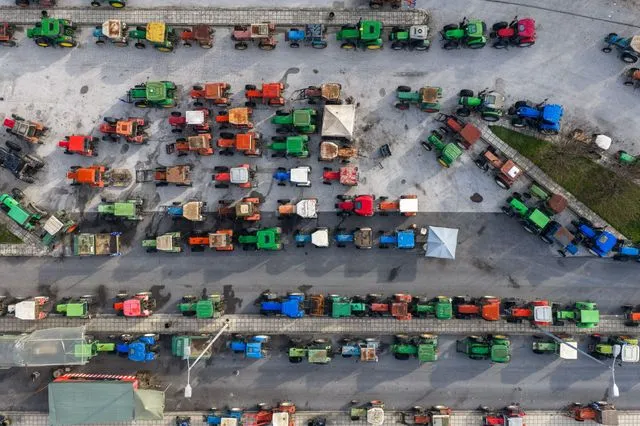
The prime minister will meet today with a group of farmers who claim to represent 14 roadblocks, after the nationwide coalition of 57 roadblocks said “no” to a meeting under these circumstances, denouncing the government’s divisive tactics.
- 13 Ιανουαρίου 2026 08:57
Farmers said “no” to what they describe as the government’s divisive tactics, after the 57 roadblock groups decided yesterday that they would not attend a meeting today with Kyriakos Mitsotakis, since their two committees would not be accepted. However, the prime minister had already arranged a separate appointment with a group that is said to represent 14 roadblocks.
How did we end up with a third “shipwreck” in talks between the government and farmers?
Last Thursday, in early January, as farmers began tightening the vise on the country’s road network -while police were unable to stop the roadblocks on bypass routes- the government, through its spokesperson Pavlos Marinakis, issued a new invitation to meet Mr Mitsotakis. Farmers responded by suspending their 48-hour blackout, while making clear that their tractors would remain lined up on the national highways, ready for further action.
On Saturday, January 10, the national roadblocks committee meeting in Nikaia, Larissa decided to send two committees to the Maximos Mansion. One would consist of 25 representatives of farmers. The second would consist of 10 representatives of livestock breeders, beekeepers and fishers.
Who are the “willing” participants for meeting No 2?
On Sunday, government officials leaked that Mr Mitsotakis would hold two meetings with representatives of farmers, arguing that “the representatives of the various roadblocks cannot agree on common representation.”
But it turned out Maximos did not mean that the prime minister would accept the two committees of farmers and livestock breeders–beekeepers–fishers appointed by the national assembly of roadblocks in Nikaia. Instead, as later emerged -and as Mr Marinakis effectively confirmed yesterday at the briefing- the government arranged the second meeting with “selected” farmers from the “14 roadblocks” said to be seeking dialogue, led by the (single) roadblock at Prasina Fanaria in Thessaloniki.
This would also include farmers and livestock breeders from Crete, who, however, decided last night not to participate after all. Institutional bodies such as ETHEAS will also not be taking part. The government, for its part, is keeping vague how many people -and exactly who- will attend this second meeting.
The “trap” the government set for farmers
These 14 or 18 roadblocks have “appeared” on two other occasions as well, but without names or signatures, and they do not include any of the major roadblocks in Thessaly and Macedonia. It is recalled that on January 7, the Athens–Macedonian News Agency (ANA-MPA) published a letter from 14 roadblocks and four cooperatives requesting a meeting with Mr Mitsotakis.
According to the report, the request was submitted by the following roadblocks: Prasina Fanaria (Thessaloniki), Kerdyllia, Mikrothives, Niseli, Skydra, Aiginio, North Halkidiki, and Western Achaia (Patras). It should be noted that the Prasina Fanaria roadblock had already split in the meantime, with those opposing a compromise with the government withdrawing.
At the same time, the government set as a condition for meeting the prime minister that there be “unified representation of farmers.” In practice, this ultimately meant that the “stamp” roadblocks—those not participating in the national roadblocks committee—should also attend a meeting at the Maximos Mansion.
Farmers realised there was a clear risk: the prime minister could tell the roadblocks, “these are the measures and there are no others”; the roadblocks would refuse, but the second group of “selected” farmers might agree—after which the government could accuse the roadblocks of intransigence.
“The government’s move is divisive. It has no interest in providing solutions. Its only concern is how to break up the farmers’ struggle. We will not take part in that,” said Kostas Tzellas, president of the United Federation of Agricultural Associations of Karditsa, speaking to NEWS 24/7 yesterday at midday, capturing the already heavy mood at the roadblocks against the government.
So yesterday, following decisions by their general assemblies, the major roadblocks in Thessaly and Macedonia began, one after another, to say “no” to a meeting with Mr Mitsotakis under these conditions. Specifically, they demanded that the prime minister accept the two committees decided by the national roadblocks assembly in Nikaia on Saturday.
The government’s new plan against farmers
Government officials, however, made it clear from the outset that the second meeting with farmers under the (half, given that it has split) Prasina Fanaria roadblock would go ahead as planned, regardless of what the national roadblocks assembly decided.
Subsequently, government sources raised the tone, claiming that the farmers from the 57 roadblocks are a “small minority” engaged in “revolutionary calisthenics.” At the same time, the meeting between the prime minister and the farmers from the 14 roadblocks was officially announced—groups denounced by other farmers as “stamp” roadblocks.
With this “two-appointment strategy,” the government’s aim from the start was to split the farmers’ front and discredit the roadblocks in the eyes of public opinion. Since the strategy of “social automatism” did not work and the majority of citizens sided with the farmers, the Maximos Mansion now wants, in particular, to present the roadblocks as intransigent and driven by political motives. It also seeks to argue that the 57 roadblocks of the national committee do not represent the majority of farmers.
Government sources even signalled that if farmers escalate again, “only the authorities are competent,” indicating that after 44 days of farmers’ mobilisations, we are back to square one.