Mitsotakis: Greece will not participate in any operation near Iran
Διαβάζεται σε 5'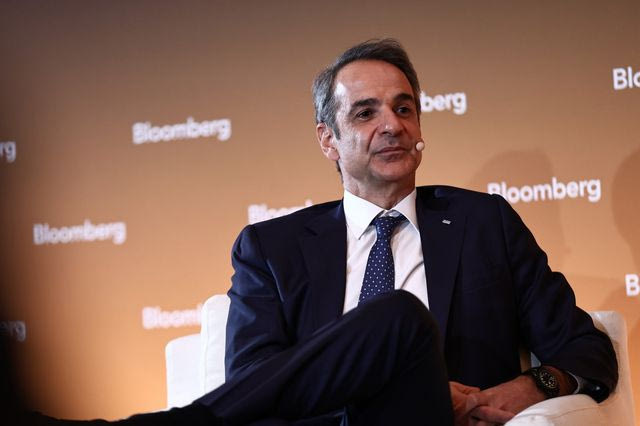
The Prime Minister conveyed to the USA that Greece will not engage in any mission in the Middle East as long as military operations continue, and called on the EU to be ready with measures for the energy crisis.
- 17 Μαρτίου 2026 14:34
The Prime Minister, Kyriakos Mitsotakis, sent a clear message that Greece will not participate in any military operation as long as the war in Iran continues and if there is no European decision, speaking at a Bloomberg conference.
Mitsotakis reminded that only Greece and Italy – and perhaps France – are participating in the EU’s “Shields” operation for the protection of navigation, which he emphasized is clearly geographically defined and does not extend to the Strait of Hormuz.
“Greece will not participate in any operation near the theater of military operations. And I doubt there is European will for such a mission now,” said the Prime Minister. When asked how he would respond if the USA requests Greece’s participation in an operation in the Strait of Hormuz, Mitsotakis answered: “We will not be involved in any activity in the broader region as long as military operations are ongoing.”
He emphasized that Greece is strengthening its defense capability and, of course, cares about the freedom of navigation. He admitted that Greek shipowners are concerned, but “clearly, this (an operation in the Strait of Hormuz) is not part of our plan now unless there is a European operation, and I think the chances of that are low.” The Prime Minister referred to Greece’s military support in Cyprus, pointing out that the Eastern Mediterranean should be a priority for the EU as a whole, and appreciated that support from other European countries was a step in the right direction.
Europe Must Be Ready for an “Energy Shock”
He estimated that Europe will not participate militarily in the war against Iran but must focus on the economic consequences. He specifically emphasized that, at the European Council on Thursday, the 27 members should examine ways to address the consequences of a prolonged war in the Middle East, especially in the energy sector.
“Greece is working towards de-escalation. We believe that the structural problems of the Middle East cannot be solved through military operations, while recognizing that Iran cannot have nuclear weapons. But now we must focus on the economic consequences of what could be an energy shock,” said Mitsotakis.
He noted that no one can predict with certainty how long the Middle East crisis will last. However, he expressed hope that it will not last much longer, adding, “I doubt anyone can achieve more from a military perspective than what has already been achieved, while as the confrontation continues, the consequences are greater than any potential gains.”
Mitsotakis’ “Realistic Green Deal”
Mitsotakis called on the EU to draw from the experience of the 2022 energy crisis. Specifically, he urged Europe to have a playbook with short-term and medium-term measures ready to be activated if necessary to support households and businesses.
He pointed out that the worst-case scenario was the closure of the Strait of Hormuz, reminding that during previous crises in the Middle East, the flow of oil and natural gas from this critical waterway never stopped completely, while now there is a risk of a total disruption.
He did not hide his concern about the price of oil and gasoline. While he noted that interventions in the European electricity market are necessary, he also supported that the Greek government’s policy in this area has been effective.
He reiterated his view that Europe must reconsider the use of nuclear energy, noting that Greece would review the issue in the medium term. Mitsotakis also argued that the EU must revise the emissions trading scheme (ETS), saying, “Having both expensive ETS and expensive natural gas is madness.”
The Prime Minister further expressed the view that it is impossible to impose high costs for the green transition in sectors like heavy industry, refineries, cement, and shipping when affordable decarbonization technology is still unavailable. He called for a “realistic green deal” so that European industry and competitiveness are not destroyed, and so consumers do not feel the consequences in their pockets.
EU Should Relax Fiscal Rules and Excise Duty on Fuels
He argued that if necessary, Europe should relax fiscal rules and reconsider European regulations on the Special Consumption Tax (Excise Duty) on fuels, which is high in the EU.
He specifically called for allowing EU member states to lower the excise duty on fuels without this cost being counted in their fiscal calculations. He clarified, however, that Greece would only reduce the excise duty on fuels if it is a European policy. He also commented that the EU cannot afford to delay this time as it did in 2022, when it took eight months to implement the cap on natural gas prices.
He made it clear that, in any case, the words “targeted” and “temporary” are key for the measures that Greece and the EU will take.