Mitsotakis’ proposal leading to “musical chairs” in Parliament
Διαβάζεται σε 4'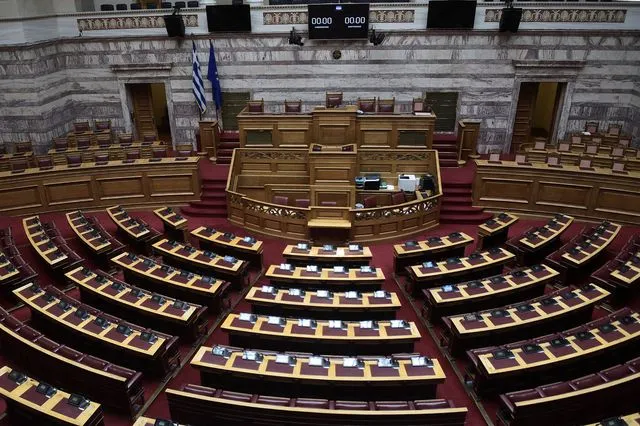
Government spokesperson Pavlos Marinakis analyzed the Prime Minister’s proposal on the incompatibility between serving as a minister and an MP.
- 06 Απριλίου 2026 19:47
Prime Minister Kyriakos Mitsotakis’ proposal to establish incompatibility between the roles of minister and MP has already sparked reactions, including within the ruling New Democracy party.
Questions have been raised regarding its institutional and constitutional basis, its political intent, and, above all, its practical implementation: How would a minister resign as an MP and then return to Parliament after a cabinet reshuffle?
It is recalled that, in a statement regarding the second case file on OPEKEPE, Mitsotakis once again spoke of a “battle with the deep state” and announced that he would propose for public discussion “a new set of institutional reforms, beyond our proposals for constitutional revision.”
Among them is the incompatibility between minister and MP, with the minister being replaced in Parliament by the first runner-up candidate for as long as they serve in the cabinet, alongside an upgrade of the MP’s role.
The Prime Minister noted that these proposals will be put to public consultation and implemented after the next national elections.
Asked how the incompatibility could work in practice, Marinakis welcomed the public debate and clarified that this is a proposal to be discussed before elections, with any changes applied afterward.
“Although the Constitution allows for implementing legislation, this proposal must be included in constitutional revision. Therefore, it requires increased majorities in this or the next parliamentary term,” Marinakis said.
Referring to the French model (despite France being a presidential system), he explained:
“We are talking about the suspension of parliamentary status for any MP appointed as minister for as long as they serve. The MP would be replaced by the runner-up. If they leave the cabinet, they return to their parliamentary seat and can run again in elections.”
“We should also discuss reducing the number of MPs”
The government spokesperson noted that under such a system, in addition to the 300 MPs, there would effectively be ministers “on standby” as MPs.
“That is why we must consider the overall proposal as it will be presented by the Prime Minister to society and to New Democracy ahead of the party congress. We should also discuss reducing the number of MPs, so that instead of 300 political offices, we don’t end up with 350,” he said.
He reiterated that all proposals are still under discussion and not final decisions. They are ideas to be included in public dialogue, along with broader institutional reforms against clientelism.
“This is a move to strengthen the role of MPs, not specifically to tackle clientelism,” he added.
He stressed that clientelism is addressed through policy, while illegal behavior is handled by the justice system.
Marinakis also stated:
“Kyriakos Mitsotakis is the Prime Minister of the digital state. Corruption is harder to occur in a digital system. He is the Prime Minister who transferred OPEKEPE to the Independent Authority for Public Revenue. So, favors are over.”
No change to the electoral system for now
Asked whether the electoral system would change, Marinakis confirmed that the 2027 elections will be held under the current law.
“If proposals arise in the future within a broader institutional framework, they will be discussed. But at the moment, the Prime Minister does not intend to change the electoral law,” he said.
He clarified that mentioning a reduction in MPs is linked to the possible implementation of incompatibility, which would otherwise increase the number of political offices.
However, he emphasized:
“I am not announcing anything. Nothing has been decided. Everything will be put to consultation with the parliamentary group and the New Democracy party.”