Tempi: The flammable wagon B2 and the practice of Hellenic Train
Διαβάζεται σε 4'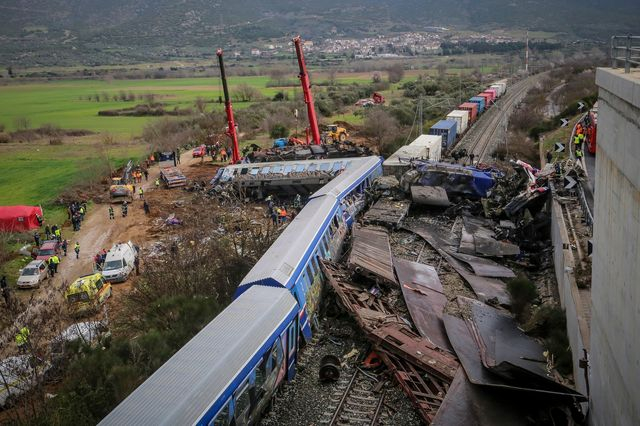
How did Hellenic Train manage to operate on the Greek railway system with flammable wagons, without new fire safety certificates?
- 08 Φεβρουαρίου 2026 14:04
Just before the Tempi disaster, in wagon B2, behind the canteen of Intercity 58, there were 81 passengers seated.
The collision with the freight train was violent, and some passengers died instantly. However, a number of passengers survived. According to the EDPo (Independent Experts Investigation Committee for Families), four of the surviving passengers were later burned alive, and the fire that killed them was independent of the fireball. It was fueled by the flammable materials in the Hellenic Train’s wagons, which did not meet any fire safety standards.
Today, we know that Hellenic Train had renovated the seats of the problematic wagon. However, they “labeled” it as a repair to avoid the need for a new fire-resistance certification. According to the latest report by the EODASAAM, the new seats in B2 were more flammable than the old ones.
But how did Hellenic Train manage this?
THE FLAMMABLE CERTIFICATES OF HELLENIC TRAIN
In the railway industry, the distinction between a repair and a renovation is not only practical but also legal, as it determines whether a wagon needs a new operating certificate from the authorities – in this case, from RAS (Railway Regulatory Authority).
When an intervention changes the technical file, such as the installation of new seats or cladding, the wagon must undergo new certification checks, especially regarding fire safety and interoperability. In the case of Hellenic Train, most of the work on these wagons took place between 2019 and 2022 as part of the fleet upgrade after the acquisition of TRAINOSE by Ferrovie dello Stato Italiane.
In wagon B2, which has a capacity of 80 seats (plus one seat for people with disabilities in certain configurations), a complete replacement of the seats was made. This work was largely carried out at the Central Factory of Piraeus and involved a full interior renewal for second-class wagons (Bmpz type).
The crucial question is whether the new materials (foam seat materials, fabrics, plastics) were fire-retardant and met European fire safety standards (EN 45545 standard).
The EODASAAM report (2/2/2026) reveals that the “old B4” sample had an aramid layer (fireproof), while the “new B4” (from recent maintenance by Hellenic Train) had plain polyester, making it much more easily flammable.
Essentially, Hellenic Train used inferior maintenance materials, even compared to the old 30-year-old seats. At the same time, its parent company, Trenitalia, follows the strict EN 45545-2 standard for its trains in Italy.
THE RENOVATION TRICK
If Hellenic Train had done a renovation based on European rules, it would have needed to be inspected and certified to meet modern EN 45545-2 standards. If they simply carried out maintenance, no certification would have been required, but at least it should have met the old UIC standard, which applied to the rest of the seats.
During the maintenance of the wagons, Hellenic Train (or the contractor) chose cheaper materials, removing the fireproof shield that existed in the old seats. The aramid layer (safety layer) was removed or never installed for cost reasons.
The strict European standard EN 45545-2 would likely have ensured that the spread of fire and the emission of toxic smoke would be zero for at least 30 minutes.
Hellenic Train chose to change the seats, with the exclusive criterion being aesthetic upgrade, without the necessary attention to safety. Thus, according to the EDPo, four people in wagon B2, who were not killed by the collision, were burned alive because the fire spread through the flammable seats.
THE DOUBLE STANDARDS AND RESPONSIBILITIES
Hellenic Train received a new certificate from the European Union Agency for Railways (ERA) in December 2022. However, this certificate is based on “compliance with national legislation.”
Ferrovie dello Stato officially claims that the trains in Greece “comply with Greek legislation,” taking advantage of the fact that Greek regulations are much more lenient than the Italian ones.
In Greece, RAS (Railway Regulatory Authority) admitted that there is no corresponding national rule for active fire suppression (water mist) in tunnels, as is required in Italy.
Thus, Hellenic Train’s wagons operated in Greece without being upgraded with modern fire protection systems because the Greek regulator (RAS) did not require them.