The “here and now” of Alexis Tsipras
Διαβάζεται σε 7'
The developments set in motion after Alexis Tsipras’ unexpected speech at the presentation of “Ithaca” involve the re-establishment of the progressive faction, the role of citizens, and the reactions.
- 04 Δεκεμβρίου 2025 08:17
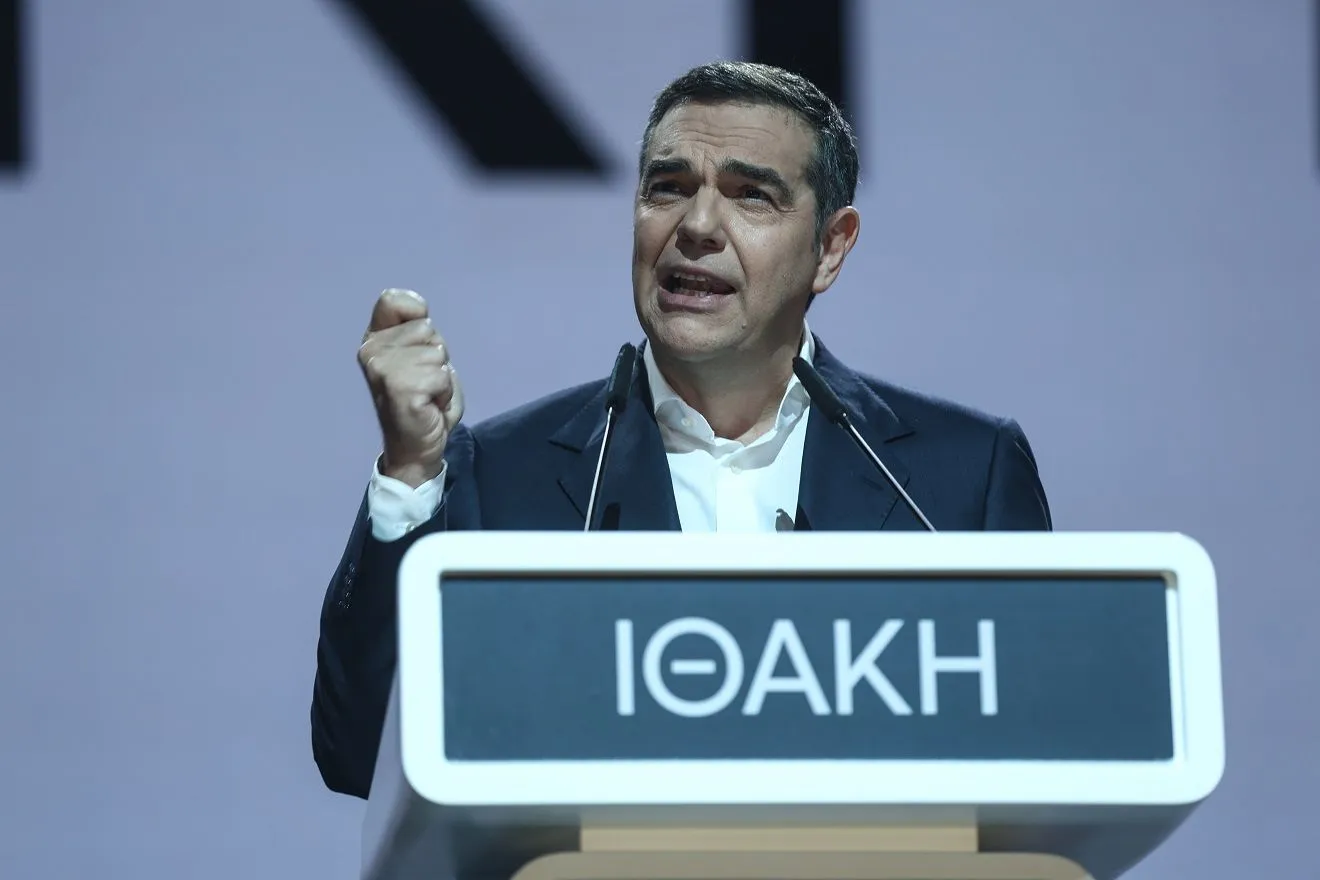
Alexis Tsipras did what everyone expected, in the most unexpected way: At the presentation of his book Ithaca at the Pallas Theater last night (December 3), he “lit the fuse” for a major political explosion (“Big Bang,” as he put it), which will pave the way for the re-establishment of the progressive political movement. He even set a time frame, aiming for the next elections.
From today—according to all indications—the country has a new political landscape, with Tsipras launching the process to validate polls that suggest he can bring balance. How? By creating a pole equal to New Democracy, built from the social base of the fragmented center-left, without necessarily relying on its leadership.
After all, Tsipras did not call on any political leadership but exclusively on the citizens, asking them to self-organize and take initiatives to re-establish the progressive space.
The Party
The phrases Tsipras used leave little room for interpretation. He emphasized that the progressive movement must “undergo processes of re-establishing its political and organizational existence,” describing in a detailed manner the creation of a party. He was specific, saying that there must be “initiatives for re-establishment, justice, and change in every city, neighborhood, region, workplace, or school.”
As Tsipras pointed out, the goal is: “A large, colorful, movement-driven, yet programmatically coherent and determined progressive faction, capable of embracing all left-wing, democratic, and socially sensitive citizens. So that it can successfully claim the progressive governance of the country in the next elections.” He even addressed the thousands gathered at the Pallas Theater, telling them they could be the beginning of this endeavor.
Thus, in a political period where—according to his assessment—the New Democracy government is ready to fall but “has no opponent,” Tsipras seemed to declare his own “Here and Now,” signaling immediate developments regarding his own activity’s intensity. He clarified that “we will be together on this journey. With our experiences and our wounds.”
Before this announcement, he analyzed all aspects of the country’s trajectory over the past decade. He launched an attack on the government (without naming Kyriakos Mitsotakis at any point) for the degradation of the economy and democracy that it has brought to the country. However, the most important part was his reference to the existence of an alternative political proposal based on principles.
As Tsipras declared, Greece needs: “A holistic National Renaissance Plan, with four pillars: Development, Redistribution, Security, and Resilience. First, we need a just and strong state that operates with rules, meritocracy, justice, and transparency. And an effective social state to heal the wounded cohesion of society.”

Reactions… from many
Alexis Tsipras’ decisive move immediately provoked a reaction from Maximos Mansion. Kyriakos Mitsotakis resorted to the past to address the issue, speaking about “ships that crashed on the rocks” during the SYRIZA government’s tenure.
However, the former prime minister had already addressed this issue in his speech at the Pallas Theater. He stated, “I am proud because we, the inexperienced ones, who didn’t come from any big political family, and no one was holding us back, succeeded where the professionals of power failed. Proud because we eventually reached Ithaca. Because many things can be blamed on me by my political opponents, but two things they can never deconstruct: That we succeeded where they failed, and we did so twice. We took the ship, battered, a bankrupt country with empty coffers and a mountain of debt, and despite the storms, we managed to reach Ithaca. To regulate the debt, restore the country’s credibility, and exit the creditors’ surveillance regime, once and for all, without any asterisks. And the second thing they can’t erase from the collective conscience of the Greek people is that our government was the most honest government in the modern political history of the country. And that cannot be erased.”
PASOK also criticized Tsipras based on the record of the SYRIZA government. In its announcement, PASOK stated, “Mr. Tsipras is identified with the past,” pointing out that “the rebranding turned out to be a rewriting of the great deception of the Greek people.” They referenced “major pension cuts, increases in the retirement age, the abolition of EKAS, the cancellation of law 3869/2010, electronic auctions, the handing over of loans to foreign funds, the increase in social security contributions, tax raids on the middle class, and the manipulation of institutions.”
However, reactions don’t seem to be limited to New Democracy and PASOK. Tsipras’ speech yesterday seems to have caused a “shock” both among the leadership and individual groups within SYRIZA, as well as within the New Left.
The leaders of both parties were present in the front rows of the balcony. And there, they received sharp political criticism. Tsipras spoke about “parties trapped in their self-satisfaction and leaderships that give the impression that they are hardly concerned if the current government wins a third term. As long as they remain in their positions.” He talked about “a picture of fragmentation and self-interest, which reproduces and multiplies social disappointment, and helps the government sustain the quagmire.”
It is certain that Tsipras’ statement yesterday will lead to developments in both spaces. However, both in SYRIZA and the New Left, despite any reactions, positions have already been recorded that view Tsipras’ criticism and the outlook of his proposals as “positive.” Even if they disagree with the manner and tone he chose to express them.
Behind the move
Alexis Tsipras’ initiative yesterday seems to carry an element of “high risk.” He simultaneously opened multiple fronts, almost exclusively investing in his relationship and interaction with the citizens.
Based on what he writes in his book, Ithaca, it appears he is following the same methodology that led him in 2012 to bring the slogan of a “government of the Left” into the political space he represented.
It is also the same reasoning that led him – as he describes – to the decision to hold the referendum of July 5, 2015. In both cases, however, he did not lose at the ballot box…