The immovable Panagopoulos and the “blue” backing
Διαβάζεται σε 5'
The refusal of the GSEE president to resign despite the investigation for embezzlement and the three top New Democracy ministers who constantly speak of the “presumption of innocence”.
- 13 Φεβρουαρίου 2026 12:40
Yesterday’s “I will not resign” by Giannis Panagopoulos may have sounded strange to citizens who have been informed about the urgent prosecutorial investigation ordered against the head of the tertiary organisation of private-sector workers on charges of embezzling EU funds. Part of the explanation for his stance, however, likely lies in the multifaceted support he appears to enjoy—some of which is provided by senior government officials.
It may be expected that a person who has held the position of GSEE president for 20 consecutive years and—according to opposition complaints—has managed EU funds for most of that period would have the backing of the PASKE faction, of which he is the head. Even the support of trade unionists from other factions is understandable, since, as he stated in yesterday’s interview regarding European funds, “no president can assign expenditures before they are reviewed by a cross-party committee.”
What is striking, however, is the way senior government officials have acted over the past 24 hours, that is, since the prosecutorial investigation became known. Through statements that—discreetly but clearly—seem to provide informal backing to the GSEE president, with the common denominator being the “presumption of innocence.”
It is worth noting from the outset that no government official has raised the issue of Giannis Panagopoulos resigning from the leadership of GSEE, despite the fact that the party of which he was a member, PASOK, suspended his party membership. This is also despite other opposition parties, such as SYRIZA and New Left, having raised a moral issue regarding his resignation from the confederation’s presidency.
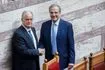
Adonis Georgiadis
Giannis Panagopoulos appears to have found a key supporter in the current Minister of Health and former Minister of Labour, Adonis Georgiadis. The vice-president of New Democracy (he also holds that position) moved almost from the outset to effectively exonerate the GSEE president. Referring to the prosecutorial report, which has not yet been made public, he argued that “it is impossible for the report to state that GSEE received €73 million because it did not. GSEE, like other social partners, with the encouragement and agreement of the EU—as is the case in all EU countries—participates in employee training programmes.”
However, Adonis Georgiadis went beyond what one might reasonably assume concerned his own tenure at the Ministry of Labour. Notably, the day before yesterday he rebuked PASOK president Nikos Androulakis for proceeding with the temporary suspension of Giannis Panagopoulos. He stated that “Mr Androulakis hates Mr Panagopoulos and apparently thinks he found an opportunity to get rid of him,” adding that “they have been intra-party rivals for years.” Just yesterday, he appeared in Parliament and indirectly linked the Panagopoulos case to the Novartis case, which—as is well known—Adonis Georgiadis considers a “set-up,” thus creating the corresponding associations.
Niki Kerameus
Labour Minister Niki Kerameus is moving along the same lines. In the bill on collective agreements currently being debated in Parliament, she has “sung the praises” several times of Giannis Panagopoulos—without naming him, evidently due to the uproar that has been created. She repeatedly refers to the responsibility shown by the social partners and to the fact that they did not serve the narrow interests of the organisations they represented but the common good, by signing the agreement on Collective Agreements, which took the form of a bill.
The commendations are clearly directed—albeit anonymously—at Giannis Panagopoulos, since among all the bodies signing the agreement, he is the only representative of employees, while all the others represent employers’ organisations. It goes without saying that in her speech in Parliament yesterday, Niki Kerameus referred to the “presumption of innocence” regarding the GSEE president.
Pavlos Marinakis
The government spokesperson Pavlos Marinakis has referred more than five times in the last two briefings of political editors to the “presumption of innocence”—a given and unquestionable element of the country’s legal order. He has even made a political commitment that the government will not “elevate” the Giannis Panagopoulos case on its political agenda.
As he stated, among other things, “I am not taking a position on this specific case, because it is still under investigation and there is also the presumption of innocence.” He pointed out that “it is a case concerning specific individuals who are under investigation and—I repeat what I said a few days ago—they will not load Mr Panagopoulos, who has the presumption of innocence, onto New Democracy.”
The DAKE trade unionists
In addition to all of the above, one cannot overlook the complaints made by trade unionists of New Democracy’s faction within GSEE (DAKE), N. Kioutsoukis and E. Theocharis, who state that “New Democracy and its ministers had excellent and ongoing cooperation with President Panagopoulos and jointly determined the policy of the Ministry of Labour and the stance of GSEE.” They even stress that “reality is harsh. Formally, the president was in PASOK. Substantively, he was in New Democracy.”