Tragedy in Violanta: What omissions are revealed by the first phase of the investigations
Διαβάζεται σε 3'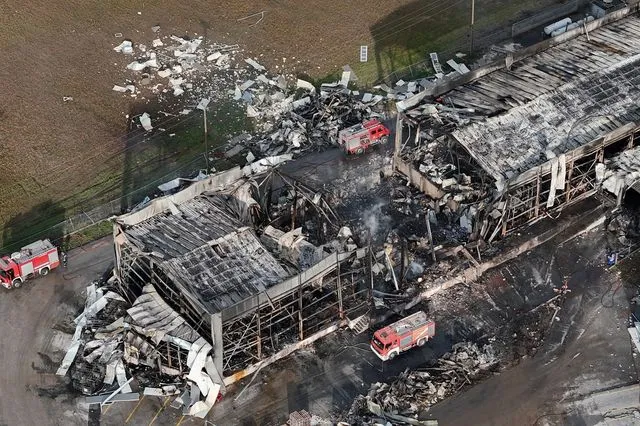
In the scenario of material failure, the authorities seem to be leaning towards the cause of the deadly explosion in Violanta. The piping was unprotected.
- 07 Φεβρουαρίου 2026 14:57
Towards construction error, not corrosion due to the bad weather ‘Daniel’, the first conclusions of the Fire Investigation Department for the deadly explosion at the ‘Violanta’ factory, at the 6th kilometer of Trikala – Karditsa, which cost the lives of five workers, seem to be leading.
According to the latest information, experienced officials from the department have formed a clear picture of the ‘path’ the propane took from the tank to the basement of the building, where the explosion occurred when a spark was triggered by the water pump.
The propane is said to have escaped from a corroded steel pipe, moved underground, and ended up in the basement of the building, exiting through three holes in the concrete. There, according to the investigation, the conditions were created that led to the deadly explosion.
Perforations at eight points
Officials from the Fire Investigation Department completed perforations yesterday over a distance of about 30 meters at eight different points along the path of the pipeline.
At all points, the presence of propane was detected, with the concentration decreasing as the investigations approached the exterior of the business and the railing on the road.
‘Daniel’ out of the picture
Based on the data so far, the scenario that the corrosion of the pipes was caused by the bad weather ‘Daniel’ is weakening. The experts from the Fire Department believe that this was a failure in the initial construction.
According to the information, the pipes were not shielded, nor was sand placed during their underground installation, as required. The pipes are steel, and it seems that there was corrosion over a length of 7.5 meters, with the specific section detaching.
Underground installation since 2014 without inspection
The pipes are said to have been constructed and installed underground in 2014 or earlier, meaning they remained uninspected for about 12 years for possible rust or corrosion.
According to the experts, as the project was constructed, it should have been shielded and sand should have been placed, which was not done.
Checks at NTUA and the General Chemical State Laboratory
The detached section of the pipe will be transferred to the National Technical University of Athens (NTUA), where detailed analysis will begin on Monday to determine the exact cause of the corrosion.
Meanwhile, soil samples will be sent to the General Chemical State Laboratory to check both the amount of propane that had been trapped in the soil and the composition of the soil to determine whether there was sand or not.
What is being examined for the works and the asphalt paving
According to the same sources, neither the bad weather ‘Daniel’ nor the asphalt paving from last August seem to directly cause the corrosion.
The possibility being examined is that these works may have compressed the soil, making it more compact, with the result that the propane moved through it like a ‘channel’ and reached the basement of the business.