Where snow chains are mandatory
Διαβάζεται σε 4'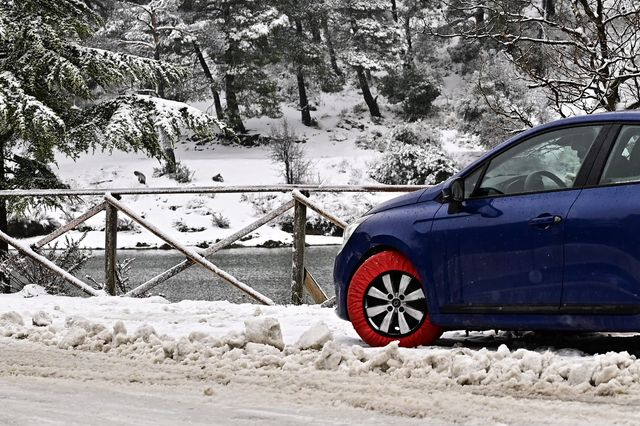
The cold snap has begun to sweep across the country, bringing very low temperatures and snowfall even to low-altitude areas.
- 12 Ιανουαρίου 2026 12:41
A severe wave of cold weather is affecting the entire country, with temperatures dropping sharply.
Already, from Sunday afternoon (January 11), the Hellenic National Meteorological Service (HNMS) issued an orange warning for a gradual deterioration of weather conditions, with very low temperatures expected to persist until the morning of Wednesday, January 14. Very strong to gale-force northerly winds will blow locally until Monday evening (January 12).
Snowfall is expected:
In mountainous and semi-mountainous areas of mainland Greece and Evia.
From nighttime hours in lowland areas of the Region of Eastern Macedonia and Thrace, in the regional units of Serres and Halkidiki, the eastern parts of the regional unit of Thessaloniki, as well as on islands of the northern Aegean (Lemnos, Lesvos, Chios, Sporades).
From early Monday morning in lowland areas of Evia (mainly its eastern parts) and in the mountainous and semi-mountainous areas of the Cyclades and Crete.
Snowfall will ease before midday on Monday in northern Greece and from the afternoon hours in the rest of the country, except for the mountainous and semi-mountainous areas of Crete, where it will continue until Tuesday morning. Due to the severe weather, several schools across the country remain closed, while traffic regulations are being implemented on the road network where required.
According to a relevant decision by the Pieria Police Directorate, mandatory equipment of all vehicles with snow chains or other equivalent anti-skid devices (if they are not fitted with special tyres) applies to the entire road network of the Regional Unit of Pieria. Special tyres (winter tyres) are defined as tyres intended for use in snowy conditions, namely those bearing the special “alpine” symbol, as specified in Appendix 1 of Annex 7 of Regulation 117 of the United Nations Economic Commission for Europe (UNECE), and the M+S marking.
The same measure applies to vehicles circulating throughout the road networks of the Regional Units of Imathia, Pella, Kilkis, Serres and Halkidiki.
It is worth noting that since March 2022, the requirement for vehicles to be equipped with snow chains “or equivalent anti-skid devices suitable for the vehicle,” as stated in Government Gazette 1144 B’, has been mandatory from October 1 to April 30 each year “whenever prevailing conditions require it.” This means that, regardless of specific decisions by the authorities, drivers are required to carry chains during this period. If a traffic police check identifies a violation, the administrative fine is €80, according to the Road Traffic Code (paragraphs 26 & 27 of Article 81).
Chains, snow socks or winter tyres
Beyond traditional snow chains—which can be notoriously difficult to fit—there are also newer alternatives that significantly simplify the process. Prices start from around €30 in online stores.
Snow socks come in three different types (and price ranges). Online, the simplest versions start at €30, while the more durable versions, suitable for asphalt, ice and snow, cost around €60. Winter tyres (specially manufactured tyres made of a rubber compound designed to improve vehicle control on icy or snow-covered roads—on properly maintained road networks, not the poor state often seen in Greece) are common practice in northern European countries, where drivers change tyres every six months due to prolonged snowy conditions each year.
Legislation also helps enforce this practice. Greece is the only European Union country that has not mandated winter tyres for a specific period, as ice and snow in urban areas are relatively rare. Presumably, those who need them choose to use them.
Which tyres should chains or snow socks be fitted on?
Your vehicle’s manufacturer manual (kept in the glove compartment) specifies which wheels should be fitted with the anti-skid device you are using.
If the car has front-wheel drive, installation should be on the front wheels.
If the car has rear-wheel drive, installation should be on the rear wheels.
Four-wheel-drive vehicles should fit them according to the vehicle’s drive configuration before activating four-wheel drive.