Tempi: Defendant turns against the ministry – “The administration knew”
Διαβάζεται σε 6'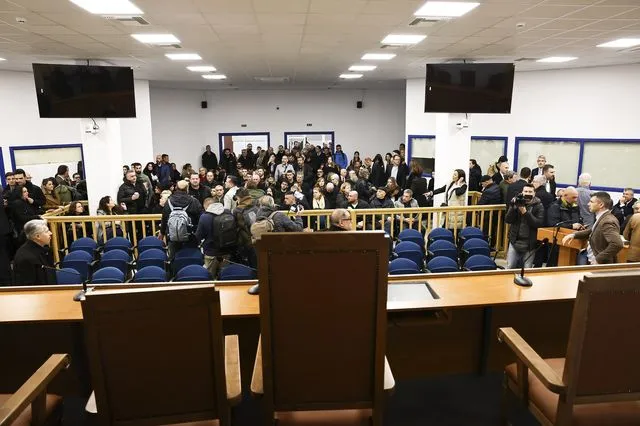
The state presents itself as a victim, but according to the defendant Dimitris Nikolaou, it is part of the problem due to the devaluation it caused.
- 28 Απριλίου 2026 20:36
Dimitris Nikolaou, an inspector from Larissa, in the context of the Tempi train disaster, is turning against the state and the Ministry, which declared its support for the accusation.
In the memorandum submitted to the court today by his lawyer, Themis Sofos, for the expulsion of the state, he argues: “The current state of OSE (Greek Railways) is perhaps one of the most difficult periods in the history of the railway in Greece, a fact that the Minister of Infrastructure and Transport knows, and he has accepted the risk to the Greek people up until today.”
The objection claims that the state cannot appear as a victim of a crime, when the very deficiencies of the railway system — which were under state supervision and responsibility — are presented as a primary cause of the disaster.
NEWS 24/7 has read the memorandum and conveys the main arguments of the first defendant, who openly turns against the state for the mismanagement of the railway.
LACK OF PERSONNEL
“The Administration knew, Spyridon Pateras knew. The CEO, my co-defendant, is the one who derogatorily referred to stationmasters as ‘traffic controllers,’ saying ‘when you know the route, you don’t need a traffic controller,’ implying complete indifference to how the Railway operates,” Nikolaou emphasizes in the memorandum.
He states that in 2018 there were 42 stationmasters in the Larissa Department, while in 2023 there were only 11. Similarly, the number of keymen decreased from 18 in 2018 to 3 in 2023.
His argument is that he operated within a framework of extreme personnel shortages, which were known to the administration of OSE, Hellenic Train/TRAINOSE, and the political leadership. Therefore, according to the objection, the state cannot present itself as a victim of the management of a problem it knew about and allowed to persist.
“The political leadership of the Ministry of Transport knew. The Minister and Deputy Minister of Infrastructure and Transport, the Minister of Labour and Social Affairs knew. Everyone who could actually do something knew and nobody did anything,” Nikolaou adds.
He further highlights several reports about shortages:
“A year before the railway accident, I urgently requested coverage for the operational needs of the Larissa Inspection Directorate, pointing out that it is necessary to hire, among others, twenty-five (25) stationmasters and sixteen (16) keymen (my letter with reference number 9029855 from 04.07.2022). Of the 25 I requested, 14 were hired, but no keyman was hired.”
NO SAFETY SYSTEMS
The main point of the objection is that the state attempts to present itself as an entity that suffered damage from the actions of the defendants, while, according to Nikolaou, the real picture is the opposite. The omissions of the state mechanism, the public railway infrastructure, oversight, and the bodies responsible for safety systems were decisive in the disaster.
The objection links the accident to deficiencies in critical safety systems: train control, signaling, ETCS, GSM-R, secondary traffic control, and overall technological and human-technical safety levels.
His argument is that these systems could have acted as safeguards against human error. Therefore, even if there was human error at the Larissa station, the crucial issue is that the system lacked a second, third, or technological level of prevention.
The accident was not only the result of an operational choice or human error but was the outcome of a system without the institutional or expected safety safeguards.
The legal weight of this argument is that it shifts the responsibility from the stationmaster or the inspection supervisor to the institutional failure of installing and operating automated safety systems.
TRAFFIC CONTROLLER
On the day of the accident, the so-called Traffic Regulator was operating in Athens, who was called to testify by the investigator and is heard in a series of recordings before the accident expressing concern about the fate of the commercial trains, and then gathering information about the position of other trains that were unknown.
“Specifically, this traffic controller was informed after the accident that there was a power and electrification outage at the point of the accident,” Nikolaou points out, adding that he had no ability to track the path of the two trains before the accident.
This instrument, based on voice information that reached it (either through the GSM-R system after 2018 or with OSE’s radio aids from earlier times or even via landline), would record on paper and precisely mark the position and path of each train.
Had it been operating on the day of the accident, according to Nikolaou, it would have provided an additional safety mechanism, potentially allowing for the monitoring of the two trains’ paths.
THE ARGUMENT FOR VASSILIS SAMARAS
Nikolaou specifically defends the decision to place Vassilis Samaras on the night shift.
According to his memorandum, Samaras was certified, the night shift had fewer routes, with 11 old stationmasters and 14 shifts, so it was necessary to use newly hired personnel, and the Traffic Directorate had approved the schedule.
He also adds: “Nowhere is it stated that stationmasters should be placed according to experience or seniority, as there are no specific criteria required. […] In fact, in other stations, like the Paleofarsalos Station, which is also a demanding and key railway hub in Central Greece, newly hired stationmasters, like Mr. Thanassakis, Mr. Golandas, and Mr. Tsaferis, have worked and continue to work alone in all shifts.”
Essentially, the state presents itself in the criminal trial as a supporter of the accusation, as if it were a third party harmed by the actions of the defendants. However, according to the defense, the case concerns a disaster that occurred within a state-supervised, understaffed, and technologically incomplete railway system.
Therefore, according to the objection, the state cannot stand in the trial as a victim against the defendants, because it is simultaneously the institutional body that should have ensured preventive measures.