The two scenarios of Greece’s indirect involvement in the war with Iran
Διαβάζεται σε 5'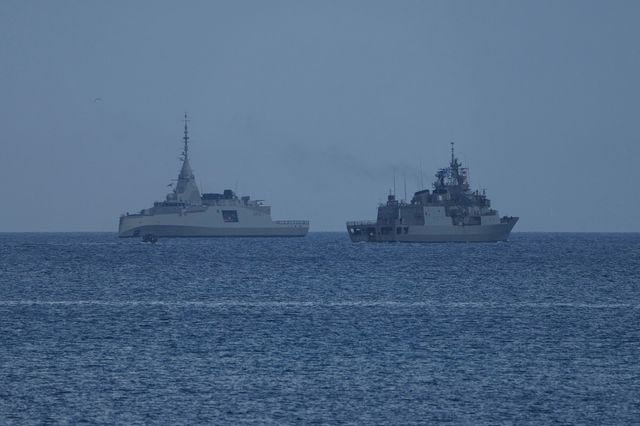
The government assures that Greece is not participating in operations against Iran and stresses that the mission in Cyprus is defensive and peaceful. However, Athens may soon be called upon to take part in two operations in the Persian Gulf.
- 05 Μαρτίου 2026 09:28
Within New Democracy there is a sense of “patriotic pride” over the support provided by the Greek Armed Forces to Cyprus. It was indicative that Prime Minister Kyriakos Mitsotakis received strong applause yesterday in parliament from the party’s MPs.
This was especially the case when he referred to the participation of the first Belharra frigate, Kimon, in the Greek mission to Cyprus. The government had, moreover, an urgent need for a “patriotic boost” to deal with internal party dissatisfaction and pressure from its right flank.
At the same time, however, the government insists that Greece is not participating in operations against Iran. It also stresses that the military assistance to Cyprus is purely defensive in nature and does not constitute, in any way, the country’s involvement in the war.
“Our mission is defensive and peaceful. It is carried out on the basis of both bilateral and European solidarity and with only one goal: to deter threatening actions against the independent state of Cyprus,” Mitsotakis said in parliament yesterday.
In his second intervention, the prime minister also rushed to respond to the Secretary General of the Communist Party (KKE), Dimitris Koutsoumbas, stating:
“Greece provided defensive support to Cyprus and not to the British bases.”
Government officials even described as fake news the revelations made by Koutsoumbas during a discussion with journalists about the alleged downing of two additional drones that were heading toward Souda.
“We have no such information and I believe we would have had it,” Defense Minister Nikos Dendias replied curtly when asked about the issue in an interview with Alpha TV.
Support for Cyprus may be a popular decision among New Democracy voters, and even among a broader audience, but the country’s substantive involvement in the war against Iran would not be equally popular. This is despite the fact that everyone understands that the American and British bases in Souda and Akrotiri respectively have likely been used quietly to some extent.
The Two Possible Multinational Operations in the Persian Gulf
However, Athens may soon be called upon to take part in two operations in the Persian Gulf, and the government will then face difficult decisions.
First, France — which since 2020 has led the Emasoh/Agenor mission in the Strait of Hormuz — is considering the possibility of a new and broader European operation to address threats from Iran and ensure that this crucial passage remains open. Greece already participates in the military component of Agenor, but it may be asked to take a more active role with warships.
It is recalled that approximately 20% of global oil trade passes through the Strait of Hormuz. In addition to Iran, Saudi Arabia, Kuwait and Iraq transport oil through this route. About 20% of seaborne shipments of liquefied natural gas (LNG) also pass through the strait, mainly from Qatar and the United Arab Emirates.
A significant share of these maritime transports is carried out by Greek-owned shipping.
The second scenario of Greece’s involvement in the war with Iran concerns the possibility of a NATO operation, in which Greece could be asked to contribute by sending warships to the Persian Gulf.
NATO Secretary General Mark Rutte stated on Monday that the alliance will not become involved in the war with Iran. However, since Donald Trump no longer rules out the possibility of a ground operation (despite the US’s bad experience in Iraq), NATO would inevitably be drawn into a multinational mission in such a case. In the naval component of such a mission, it would be logical and expected for Greece’s assistance to be requested as well.
The Government’s Difficult Dilemma
In his interview yesterday, Dendias did not rule out any possibility, although he appeared particularly cautious. He first recalled that the frigate Hydra is already deployed as part of the European operation “Aspides” off Djibouti, “precisely to protect sea lanes of communication and the interests of Greece and Greek-owned shipping.”
From that point on, he said, “we will see” whether a broader operation emerges, especially a European one. But he stressed that the Greek government will also weigh the risks for the Hellenic Navy.
“For us, the safety of our personnel always comes first,” he emphasized.
“I cannot rule out anything, but I also cannot agree to everything,” the defense minister said, adding:
“However, we are very far from that at this moment.”
He also referred to the great difficulty and danger of such an undertaking in what he described as Iran’s “soft underbelly.”
“It is not simple at all,” he stressed, adding that he would not place naval personnel at risk unless that risk was fully calculated and their lives adequately protected.
It is evident, moreover, that the regime in Tehran — although weakened — still retains operational capabilities and has mainly launched a war of attrition against everyone in the region. Its aim is to raise the economic cost of continuing operations against it and to exhaust the defensive stockpiles of the United States’ allies in the area. Drones cost far less than fighter jet sorties and air-defense systems.
Since Saturday, there have already been attacks on ships in the Strait of Hormuz, mainly vessels flying the American flag. At the same time, the threat of mining the critical maritime route for oil and LNG transport remains on the table.