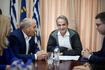
Mitsotakis to ND MPs: Say no to miserable introversion
Διαβάζεται σε 9'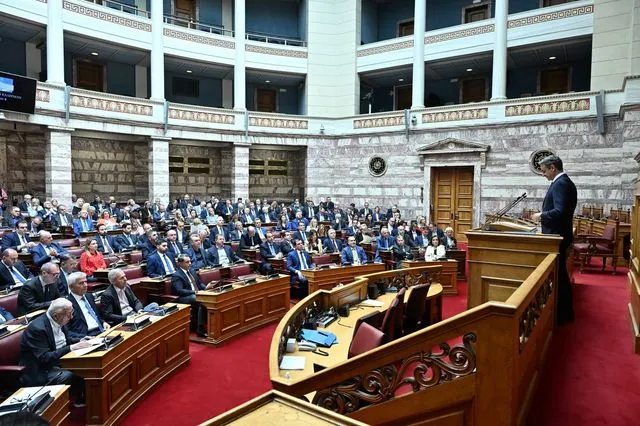
During a meeting of the blue Parliamentary Group, Prime Minister Kyriakos Mitsotakis set clear red lines for dissenters. He assured that the MPs, whose immunity was lifted due to the OPEKEPE case, would still be candidates.
- 07 Μαΐου 2026 13:33
Prime Minister Kyriakos Mitsotakis immediately sought to quell any potential criticism from New Democracy MPs in his speech during the Blue Parliamentary Group meeting.
“We have many hours ahead of us to give the floor to those who wish to speak about constitutional revision and more, but they must be aware of the environment around us,” Mitsotakis began.
He wanted to reassure dissenting MPs that they would be heard (noting that 48 MPs from ND had requested to speak, each being given five minutes). However, he set a framework for these discussions, referring to the ongoing war against Iran, which has significant economic impacts.
“It is important to understand that while what we discuss internally within our party is important, it must also align with the expectations, fears, and problems of the citizens. Today, the biggest problem for citizens is inflation, and what they expect from us are ways to relieve it,” noted the Prime Minister.
He emphasized the need “to always speak in the language of the citizens, not projecting our own concerns and insecurities in an internal discussion.” He asked ND MPs “to be honest and productive, making references that interest the citizen, avoiding miserable introspection.”
Seven Years in Government, Logical Discussions
Mitsotakis also commented that “after seven years in government, it is logical to give rise to such discussions.” He referred to the fact that, as the Secretary of the ND Parliamentary Group Maximos Charakopoulos had pointed out earlier, after seven years of governance, New Democracy remains the leading party with more than double the support of the second-largest party.
“We remain the only national force of certainty, safety, and prospects,” the Prime Minister stated. He argued that a third term for New Democracy would prevent the country from returning to 2015, but stressed that the blue party “has much more to do for Greece in 2030, fortifying defense and continuing the dual path of development and social support.”
He also referred to the constitutional revision process as a key focus of this effort, calling it a major step forward and a necessary institutional rupture. He did not mention the proposal for incompatibility between ministers and MPs, although it is part of the 30 proposals for constitutional revision distributed to MPs. Furthermore, he noted that reducing the number of MPs is not part of New Democracy’s proposal for constitutional revision (as it is unnecessary and only requires a law).
The Prime Minister assured the MPs that a dialogue would open on strengthening the role of MPs and establishing rules for the democratic functioning of political parties.
Mitsotakis criticized the opposition for its confusion and silence on constitutional revision, claiming that the opposition “doesn’t care about the future of the country. Its exclusive concern is how to fabricate scenarios to undermine the credibility of the government and the morality of the party.”
All our MPs will be on the ballots
He then publicly stated something he had already conveyed to many ND MPs privately regarding the lifting of immunity due to the OPEKEPE case. “I want to congratulate the Parliamentary Group for its stance regarding the European Prosecutor’s Office files,” said the Prime Minister, adding, “Our MPs proved that a clear sky does not fear lightning. They opened the way for the vindication of those who were accused.”
He emphasized that this process must be swift.
The Prime Minister noted that, in the speeches of the 13 MPs, whose immunity was lifted, he saw “dignity and justified bitterness,” but declared that they did the right thing and added, “Just as our MPs did the right thing, the European Prosecutor’s Office must also act swiftly, avoiding selective leaks in doses and dispelling the impression that it is involved in political disputes.”
Mitsotakis assured the Blue Parliamentary Group that, as he had told the directly concerned parties, “All our MPs will be on the election ballots if they wish. Without final court decisions, the presumption of innocence applies.”
The personal success of each of us is only achieved through the victory of ND
He stated that at ND, “We are a united front and we proceed as one,” adding with emphasis, “However, we are also a force of responsibility, and from now on, we will not allow the Parliament to become a continuous court of impressions. Daily life will not be subjected to self-appointed prosecutors.”
He condemned the opposition for toxic poison aimed at undermining the integrity of the ND party, referring to accusations of the party being a “mafia,” a “gang,” and a “criminal organization.” He commented, “But who is the ruthless one is also evidenced by the ongoing battle for life by Giorgos Mylonakis.”
Mitsotakis stressed that the Blue Parliamentary Group’s duty is not to ignore weaknesses or mistakes, adding, “I think our Group is called to operate based on three principles. First, the title of MP is the highest honor. Second, in a party, everyone must always be ready to serve in any position. Third, each of our personal successes comes only through the victory of ND.”
Thus, he sent a dual message to ND MPs: that law-abiding MPs have a chance for a position in the next cabinet reshuffle, and that their re-election is secured with ND’s victory and his own re-election as Prime Minister.
The thin red line of Mitsotakis
Mitsotakis also told MPs, “Let’s not hide mistakes, let’s voice objections, but always accompany them with useful alternative proposals. Knowing that the line between concern and introspection is thin. However, this line is red.”
He promised to continue his intensive contacts with MPs, saying, “I don’t think you have difficulty communicating with the Prime Minister’s office.” He also assured that, “We can improve our monitoring of government work with not only time-based but also geographical indicators, so you can set the tone as representatives of every region.”
The Prime Minister further noted, “We still have several months until the elections,” and asked everyone to “be present in the Parliament, even if logically and understandably, all eyes are turning towards their re-election.”
He stated, “To win the third elections—it’s not easy—we must sweat for it. And we will sweat together, and I am confident of that.”
Charakopoulos: MPs’ interventions do not constitute rebellion
Opening the Parliamentary Group session, Charakopoulos initially commented that, “For days now, the media spotlight has been focused on our proceedings. The conclusion is that the ND Parliamentary Group is a lively, creative organism, where government decisions meet the concerns of society.”
The Secretary of the ND Parliamentary Group emphasized that MPs’ role is to convey the problems and concerns of citizens, adding, “MPs are the best pulse readers of society. They quickly grasp the mood of the people.”
He further stated, “The interventions of MPs are not an annoyance, a dissonance, and certainly do not constitute rebellion.”
Charakopoulos stated that ND, as a liberal party, always seeks proposals and objections, “because these can correct the wrongdoings.” He characterized ND as an “open, inclusive, dialogue-based party, both traditional and modern, popular and progressive, patriotic and European.”
He also pointed out that some are aiming for toxicity and scandal-mongering, as in the past with the Vatopedi and Novartis scandals, and said, “We will shock them with a positive agenda.”
30 articles of the Constitution for Revision – ND’s proposal
After Mitsotakis’ speech, ND’s spokesperson for constitutional revision, Evripidis Stylianidis, will take the floor to present the government’s key proposals.
ND’s proposal will essentially form the basis for discussing the revision of 30 articles of the Constitution and is a synthesis of various thoughts publicly expressed by the Prime Minister over time and the proposals made by over 50 blue MPs within the internal party process.
The government intends to start the process of constitutional revision in Parliament in May when the relevant proposal will be submitted with the signatures of 50 MPs. Following this, in May, Parliament President Nikitas Kaklamanis will form and begin the work of the Constitutional Revision Committee.
So far, ND has proposed the following articles of the Constitution for revision:
- Article 5 (Free Development of Personality, Personal Freedom) for protecting individual freedom and security from artificial intelligence.
- Article 16 (Education, Art, Science) for establishing private universities.
- Article 30 (The President of the Republic as the Regulator of the Polity) for a single six-year term for the President.
- Article 51 (Election of MPs, Electoral Rights—specifically for postal voting) and Article 54 (Electoral System, Electoral Districts, MPs of the National List) for electoral law reform.
- Article 86 (Prosecution of Government Members, Special Court) regarding the criminal liability of ministers.
- Article 90 (Supreme Judicial Council) for the selection of judicial leadership.
- Article 101A (Independent Authorities) for independent authorities.
- Article 103 (Public Employees) for the redefinition of the permanency of civil servants.
Additionally, it has raised the following issues:
Access to affordable housing
- Fiscal “brake”
- Functioning of political parties
- Climate crisis.