What is causing the strong gas odor in Attica – Expert explains
Διαβάζεται σε 6'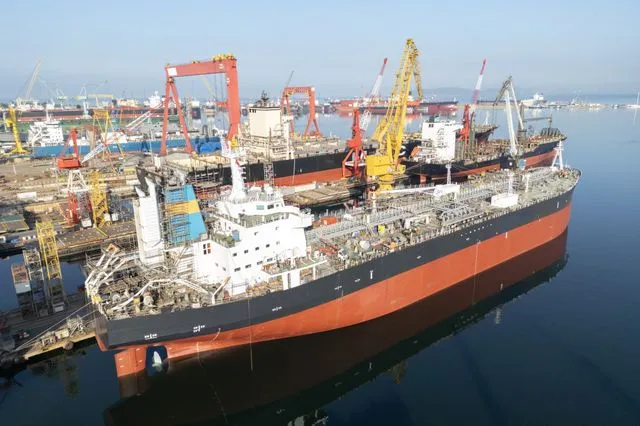
Demosthenes Sarigiannis, President of the National Hellenic Research Foundation, explains to NEWS 24/7 the two scenarios behind the foul odor that “choked” Attica on Tuesday.
- 20 Μαΐου 2026 14:21
It has become clear that every time a problem arises in Greece, the initial briefing seems aimed more at causing confusion rather than revealing the cause, or clarifying whether our lives are being put at risk.
One of the most recent examples is what happened during the Athens FIR blackout, where the Civil Aviation Authority’s first announcement attributed the problem to a “massive, unprecedented interference” across all frequencies of the capital’s airspace.
The final report did not assign responsibility to anyone, but a NEWS 24/7 report revealed that the actual issue was that all frequencies ended up on the same circuit—and that it was subsequently decided to create different circuits so that all frequencies wouldn’t collapse together.
Are you shocked by the inability to fix the obvious before it causes a problem?
Let’s move on to the foul odor that “choked” us on Tuesday afternoon.
Officially, no problem was found
The intense odor, which resembled a natural gas leak, “blanketed” Attica—particularly the southern suburbs—and various theories immediately began to circulate.
The authorities made a statement hours later to inform us that upon completion of the checks at the distribution point, no problem was found. In other words, there was no leak or dangerous environmental pollution.
Officially, then (from a government spokesperson), we have not heard what went wrong.
“The source of the strong odor is at sea”
We contacted Professor Demosthenes Sarigiannis, an environmentalist who serves as the Director and President of the Board of the National Hellenic Research Foundation. His team conducted all the necessary measurements over the past few hours to provide us with a clearer answer regarding the cause of Tuesday’s discomfort. He clarified the following:
“The picture we have is that the source is at sea, at two possible locations. This means two different scenarios.
One location is the channel between Perama and Salamis, specifically in Selinia, where there are shipyard facilities used either for ship repairs or shipbreaking—in Salamis, it’s shipbreaking.
In both cases, due to the nature of the operations and works carried out there, remnants of molecules used as tracers in natural gas transport—such as mercaptans—or hydrogen sulfide residues can be stirred up. These can disperse and produce the odor that occurred. That is the first scenario.
The second scenario is that a tanker anchored in the main anchorage area of the Saronic Gulf, outside Aegina, was undergoing tank cleaning operations. The same logic as the first scenario applies here, meaning residues from tracer molecules created this odor.”
What are tracer molecules?
Tracer molecules in natural gas are what give it that unpleasant (rotten egg) smell. These are specific chemical compounds artificially added to natural gas—which is otherwise odorless and colorless—for safety reasons. Consequently, without them, a leak would be impossible to detect by smell.
This carries risks of explosion and/or poisoning. This is why, as the Professor notes, if you are at home and smell this characteristic odor, you must alert authorities immediately, because if it is a leak from an individual natural gas boiler, things can become very dangerous.
Was the strong odor in Attica dangerous to our lives?
The situation became so unbearable that an alarm was raised, with the Fire Service, the Coast Guard, and crews from the National Natural Gas System Operator (DESFΑ) deploying primarily to the southern suburbs, where the odor was most intense, in an effort to locate the cause.
Schools and offices were evacuated, raising the reasonable question of whether we were in danger.
The expert reassured that what happened was not dangerous “because we, as humans, put these molecules into natural gas so that we can smell a leak and take timely action.”
Is what we inhaled (whatever the air carried from the source of the problem to our lungs) dangerous?
“The only thing it does is cause discomfort. To define it strictly scientifically, I would say it has a mild neurotoxicity. This is what we characterize as discomfort.”
“It has happened three times in a year and it will happen again”
In this country, there is never a warning for any given phenomenon; we experience it first and then look for answers on our own. Could there have been a warning on Tuesday? Yes, especially since this was not an unprecedented event, but rather a “seasonal” one.
Demosthenes Sarigiannis pointed out: “I believe that what happened will happen again, because it has happened before. Such phenomena occurred in February, as well as last year around this time, just three days apart.
This is also an indicator that demonstrates the seasonality of certain non-continuous operations in Salamis and Perama. In other words, shipyard works like tank cleaning do not happen constantly.
Your colleagues asked me if work is carried out continuously at the shipyards, given that it doesn’t smell all the time. The answer is that it does smell constantly if you visit Drapetsona.” It appears that the odor travels from there across the rest of Attica under specific circumstances, which the relevant authorities should now be aware of—at the very least, to inform citizens in a timely manner.
The National Hellenic Research Foundation also conducted an additional check: “Just like rewinding a movie, we rewound the air masses from 1:00 PM when they reached both Voula and Drapetsona, tracing how they moved backward.
We saw that the trajectories converge on specific points. These are the ones I mentioned to you. We did the same work for the days these episodes occurred last year, and the same points appeared. Therefore, there is something there; it cannot be a coincidence.”