What seismologists are saying about Evia – Inspections have begun
Διαβάζεται σε 4'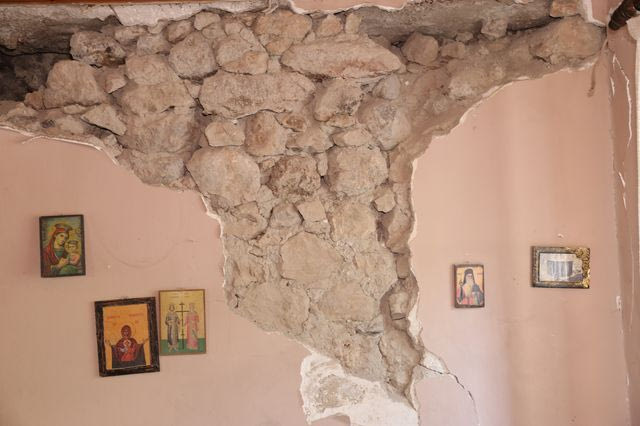
At least 112 seismic tremors have already been recorded within a very limited geographical area, while inspections have begun in the affected regions.
- 08 Ιουνίου 2026 13:20
The initial data regarding the seismic activity in Evia (Euboea) are considered reassuring, according to scientists from the Geodynamic Institute of the National Observatory of Athens, who are closely monitoring the evolution of the phenomenon.
According to information released following a brief update, at least 112 seismic tremors have already been recorded within a very limited geographical area, a development that is viewed positively. On the one hand, it provides scientists with a substantial amount of data for analysis, while on the other, it strengthens the assessment that neighboring and potentially more dangerous fault lines have not been affected.
Experts estimate that the 5.2-magnitude earthquake that struck around midday the previous day may have been the main shock, while still maintaining some caution, as is customary with any natural phenomenon. The 4.3-magnitude aftershock recorded in the early hours of the morning further supports this scenario, with seismologists noting that the intense aftershock sequence is helping to release accumulated seismic energy.
Along the same lines, geology professor and President of the Greek Earthquake Planning and Protection Organization (OASP), Efthymios Lekkas, appeared reassuring, stating that “it did not concern me; we are on the right track.” As he explained, the occurrence of numerous earthquakes of this magnitude is an indication that the process is gradually subsiding. He added that, based on historical data and the characteristics of the area’s fault systems, earthquakes exceeding 5.3 magnitude are rare.
Despite the positive outlook, authorities and scientists are urging residents to remain cautious, particularly those living in older buildings. Increased vigilance is recommended over the next 48 hours, while in some cases residents are advised to avoid spending the night in old stone-built houses until the main phase of aftershock activity has passed.
70 Aftershocks Recorded Overnight
Approximately 70 aftershocks were recorded during the night, five of which exceeded magnitude 3.0, while one reached magnitude 4.3. According to an update from the Ministry of Climate Crisis and Civil Protection, this pattern further strengthens the assessment that the 5.2-magnitude earthquake was the main seismic event.
Damage to Buildings – Schools Closed as a Precaution
Regarding the damage reported so far, the Ministry of Climate Crisis and Civil Protection stated that it mainly concerns older homes in the villages of Prokopi and Dafnousa. Two inspection teams from the General Directorate for the Restoration of Natural Disaster Effects have been dispatched to the area to assess and document the damage.
Inspections Underway in the Affected Areas
Meanwhile, teams from the General Directorate for the Restoration of Natural Disaster Effects (GDAEFK), under the coordination of the General Secretariat for Natural Disaster Recovery and State Aid, have been operating since the early morning in the areas of Prokopi and Dafnousa in northern Evia. Their mission is to conduct inspections and record damage caused by the seismic activity.
The teams are carrying out checks on homes and other damaged buildings in order to obtain an immediate assessment of the extent of the destruction and initiate the necessary recovery and state assistance procedures.
At the same time, according to a statement from the Ministry of Climate Crisis and Civil Protection, authorities are working closely with the Municipality of Mantoudi–Limni–Agia Anna and the Region of Central Greece to ensure the fastest possible documentation of the impacts and effective support for local residents.
“Yesterday, throughout the development of the seismic activity, the competent services and scientific institutions continuously monitored the phenomenon and evaluated the emerging data. From the early hours of this morning, with a clearer picture of the consequences, GDAEFK teams have been present in the affected areas of northern Evia and are systematically recording the damage caused by the seismic activity,” said Kostas Katsafados, Deputy Minister for Climate Crisis and Civil Protection responsible for State Aid issues.
He added that, in close cooperation with local and regional authorities, the government is moving “swiftly with the necessary inspections so that the assessment of the impacts can be completed as soon as possible and all the prescribed support measures for affected residents can be activated.”
“The state remains present and will continue to stand by the residents of the area throughout every stage of the recovery process,” Mr. Katsafados stressed.