For the first time, Greece did not vote in favour of lifting the US embargo on Cuba
Διαβάζεται σε 5'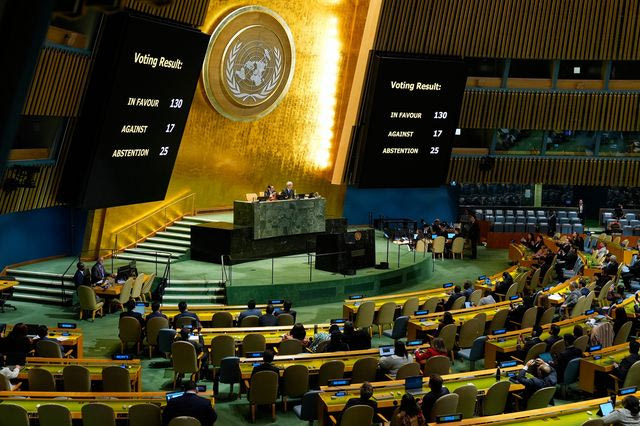
The United Nations General Assembly once again called for an end to the US embargo on Cuba. However, following pressure from Washington, the number of countries opposing the resolution reached an all-time high. Greece was among the countries that did not support it.
- 29 Οκτωβρίου 2026 15:31
The UN General Assembly once again adopted, by a large majority, a resolution calling for an end to the US embargo against Cuba, although it received the lowest number of votes in favour in the past 30 years.
For weeks, Havana had accused Washington of launching a diplomatic offensive aimed at persuading various countries to withdraw their support for the legally non-binding resolution submitted by the Cuban delegation.
The resolution, which calls for the lifting of the US economic, commercial and financial embargo against the communist-ruled island, was adopted with 130 votes in favour, 17 against and 25 abstentions. This was the lowest number of votes in favour since 1995.
Notably, for the first time, Greece was among the countries — alongside Germany, Italy and others — that chose to abstain, apparently aligning itself with the US position. This marked a departure from the stance of major European powers such as France, the United Kingdom and Spain, which maintained their support for ending the embargo.
The resolution
The resolution, which has been submitted annually since 1992, included a specific reference this year to the consequences of the oil blockade imposed by the US administration on the Caribbean nation over the past nine months.
For many years, Havana secured almost unanimous support for the resolution at the United Nations. In 2004 and 2005, it received more than 182 votes in favour, although the United States and Israel have consistently voted against it.
“Once again, the majority of the world stood against the blockade, despite the pressure and blackmail exerted in the most brazen manner by the United States in an attempt to change the outcome of this vote,” Cuban President Miguel Díaz-Canel wrote on X.
At UN headquarters, Cuban Foreign Minister Bruno Rodríguez accused Washington of seeking to “determine the fate” of his country and “appropriate” its wealth.
“The blockade is killing and silently punishing our population as never before,” Cuba’s top diplomat added from the podium.
Shortly before the vote, US Ambassador to the UN Mike Waltz denied that Cuba was subject to a blockade, arguing instead that the “shortages” faced by “the Cuban people are solely the fault of the corrupt communist regime.”
The US permanent representative also said that his country had sold $875 million worth of goods, including fuel, to private-sector companies in Cuba between January and August.
“The communist regime does not like that expression, ‘private sector’,” he added.
Two days earlier, Waltz and Rodríguez had exchanged sharp criticism and harsh words during discussions on the resolution. Waltz denounced the lifestyles of Cuban officials and political repression in the country, while Rodríguez called him a “liar.”
According to estimates by Havana, the US embargo, which has been in place since 1962, has caused record economic losses, reaching $8 billion between March 2025 and February 2026. This was before the oil blockade was imposed and Washington announced successive rounds of new sanctions against state-owned enterprises and officials on the island.
It should be noted that while the UN vote carries political weight, only the US Congress has the authority to lift the embargo.
The 193-member UN General Assembly has adopted the resolution annually for more than three decades — with the exception of 2020, during the COVID-19 pandemic — with no significant changes to its wording.
KKE: Greek government’s stance at the UN General Assembly is disgraceful
Greece’s position prompted a reaction from the International Relations Department of the Central Committee of the Communist Party of Greece (KKE), which stated in an announcement:
“Once again, the New Democracy government found itself on the wrong side of history when, after 33 years, it abstained from voting at the UN General Assembly on Cuba’s resolution demanding an end to the imperialist blockade. Its stance is disgraceful and unacceptable! Alongside a handful of other countries, it aligned itself with the US campaign against Cuba’s resolution, even though the resolution was adopted by a large majority of 130 countries in the General Assembly.
The New Democracy government’s decision is yet another indication of its involvement in the imperialist US-NATO plans against the peoples of the world, at a time when the Trump administration is intensifying its threats, even raising the prospect of armed intervention against Cuba.
Its stance makes it complicit in the ongoing crime of the blockade, which causes immense suffering and deprivation for the Cuban people, and paves the way for accepting the pretexts for and supporting a possible imperialist intervention — another crime.
Unfortunately for the New Democracy government, the Greek people harbour deep and widespread feelings of friendship and solidarity towards the heroic people of Cuba, who have resisted the brutal blockade and US threats for more than 60 years.
The KKE will continue to take a leading role in expressing its internationalist solidarity with the Cuban Revolution and its people through concrete action, and in condemning the imperialist aggression to which the Greek government is now also contributing.”