Alexandros Giotopoulos surrenders: Escorted back to prison by police convoy
Διαβάζεται σε 3'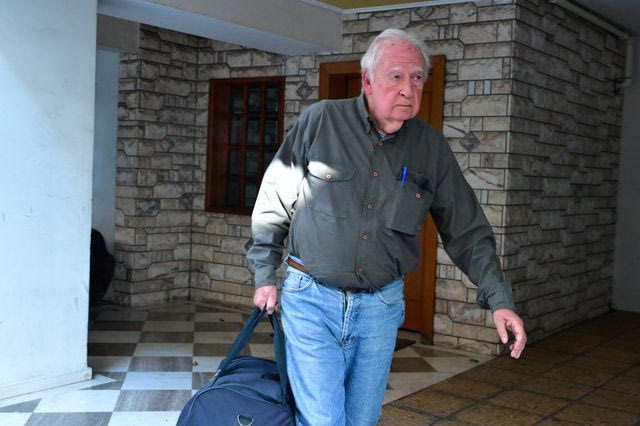
Alexandros Giotopoulos is returning to prison by taxi, escorted by police patrol cars, following the Supreme Court’s decision to overturn the ruling that had granted his release.
- 15 Ιουνίου 2026 19:36
The Supreme Court’s annulment effectively nullified the Appeals Council’s judgment, which had found that the legal requirements for his conditional release had been met.
It is recalled that Deputy Prosecutor of the Supreme Court Sofoklis Logothetis, after reviewing the ruling of the Piraeus Appeals Council that ordered the release of the alleged 17 November leader known as “Lambros” under specific conditions, concluded that an appeal should be filed. As a result, the competent Judicial Council of the Supreme Court convened and issued its decision.
The Arrest of Alexandros Giotopoulos
On July 17, 2002, Giotopoulos was arrested by Greece’s counterterrorism unit on the island of Lipsi. He was charged with moral instigation in murders, robberies, and bomb attacks, as well as participation in the terrorist organization 17 November, based on testimonies from co-defendants and evidence found by police in apartments used by the group.
From the outset, he denied all charges, claiming that co-defendants had implicated him in order to receive favorable treatment under the anti-terrorism legislation introduced at the time.
By decision of the Appeals Council, he was referred to trial on charges of moral instigation for all actions carried out by the organization from its founding until July 2002, while being identified as its leader and chief strategist.
He filed a request to annul the indictment, but it was rejected by the Criminal Division of the Supreme Court.
Trial and Imprisonment
At first instance, the Three-Member Court of Appeal for Felonies sentenced him to 21 life sentences and 25 years in prison, a ruling he described as being dictated by foreign interests.
Following the court’s decision, he was transferred to Korydallos Prison, where he had already been held in pre-trial detention.
In December 2005, the second-instance trial began before the Five-Member Court of Appeal for Felonies. During the proceedings, Giotopoulos withdrew from the courtroom and revoked the authority of his two lawyers, Giannis Rachiotis and Kostas Chrysikopoulos, to represent him. The court subsequently reappointed the same lawyers. After a series of court-appointed defense attorneys, Giotopoulos returned to the proceedings in order to place his views on record ahead of an appeal to the European Court of Human Rights, but the court refused to allow him to appoint a lawyer of his own choosing. Eventually, following the resignation of one of the three appointed lawyers, he was allowed to appoint a lawyer of his choice, while the other two remained formally present.
The Five-Member Court of Appeal for Felonies ultimately sentenced him to 17 life sentences for the same offenses.
Following the appellate ruling, he filed an appeal before the Supreme Court seeking its annulment, but the request was rejected. In April 2011, he filed an application before the European Court of Human Rights.
In March 2010, the Greek Ombudsman ruled in Giotopoulos’ favor after prison authorities had rejected his request to use a computer for educational purposes.