Tsipras: Free transport, abolition of nationwide exams, and three other measures for citizens
Διαβάζεται σε 5'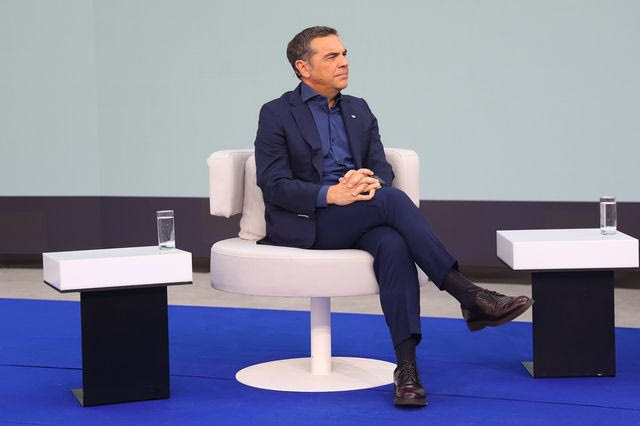
Former Prime Minister Alexis Tsipras outlined five interventions that, he claimed, could immediately improve citizens’ daily lives.
- 12 Ιουνίου 2026 16:02
Tsipras presented this set of five priority measures at the panel of the 7th OT FORUM.
In response to a question about the main programmatic priorities of EL.AS., the former Prime Minister described five interventions that, according to him, could directly enhance citizens’ everyday life.
He stated that the five priorities are:
- Minimum guaranteed amount of electricity at a stable price for everyone
- Public body for the social management of housing loans
- Free transport in Athens and Thessaloniki for all citizens except tourists
- Abolition of nationwide exams
- Inclusion of teachers in the special payroll system and wage increases for nurses and doctors
Energy cost as the first priority
He started by placing the issue of high energy costs first. “I would put at the top the issue of the high energy cost for businesses and households. According to official data, Greece along with Bulgaria ranks last in the European Union at 19.2%. Energy poverty affects 1 in 5 households.”
Tsipras commented that “we have worked out, utilizing the new guidelines of the European Commission, the possibility of creating long-term fixed contracts between providers and renewable energy producers. This is possible, provided that DEI (Public Power Corporation) plays a different role, adopting a different policy under the leadership of a progressive government.”
He added that “DEI should play a role in guiding competition for the benefit of the consumer. We have therefore found a way to guarantee a minimum amount of electricity at a stable, affordable price for households and businesses, so that, on average, bills decrease by 30%. So, the first priority is energy cost.”
Housing issue
His second priority was housing, with special reference to non-performing housing loans. “Everyone says that banks have offloaded non-performing loans. That is half the truth. The other half is that loans remain a burden on citizens-borrowers. Funds bought them relatively cheaply at 20%-30% of their value and demand repayment from citizens at 80%-90%.”
“We have studied and designed a public body for the social management of housing loans, as well as another public body responsible for housing policy. All unused public real estate will be transferred to this body, along with public property reserves. There will also be an agreement with the funds to transfer the non-performing loans, so that the state does not demand extremely high repayments or proceed with foreclosures, but the borrower has the option to purchase at a low price, slightly above what the funds paid, offering substantial arrangements, long-term low installments, and long repayment periods,” said the EL.AS. president. He added, “For those who cannot pay, we are not creating moral hazard. Strategic defaulters will not have their homes taken by others but will go into social housing. This is a comprehensive plan to solve a very important social problem and pursue a policy that supports society.”
“Free public transport in major cities”
The third measure concerns providing free public transport in major urban centers for all citizens of the Athens metropolitan area and Thessaloniki, where there are public urban transport systems. “For all, except tourists. This has a fiscal cost of around €200–250 million for Athens and Thessaloniki, which is low. It is almost one-quarter of the various passes Mr. Mitsotakis provides and has multiple social and economic benefits,” he emphasized.
“It reduces transportation costs for lower-income groups. Who uses the metro and buses? Young people and working-class citizens who pay €80 per month. This is not insignificant and it is also environmentally friendly. It reduces traffic and boosts demand in neighborhoods and local markets,” he noted.
“Abolition of nationwide exams”
“The fourth measure concerns the younger generation and is, I believe, now a mature demand. We had legislated it, but Mr. Mitsotakis abolished it. This is a collective failure of society to maintain a psychologically taxing system for the younger generation simply because it is impartial and we cannot hand over something more impartial to the next generations. We have designed an admission model that provides a new understanding of learning, knowledge, and opportunities for all children to access higher education, not only those from affluent backgrounds,” said the former Prime Minister.
He noted that currently only 1 in 10 children from low social and educational backgrounds can enter Greek universities.
“Salary increases for doctors, nurses, teachers, and educators”
The fifth measure, according to Tsipras, aims to improve the daily lives of doctors, nurses in the NHS, and teachers.
“It reflects the quality of our society today. We should not have teachers and educators instructing our children while earning €800—it is a shame. We should not have surgeons, doctors, and nurses in the National Health System experiencing burnout while being paid meager, undignified salaries. Inclusion of teachers in the special payroll and an average increase of €500 for NHS doctors and nurses is required. I believe this measure will upgrade both public health and public education, which are critically needed in our country,” he said.