Tsiaras’ response to farmers’ demands – Call for dialogue
Διαβάζεται σε 7'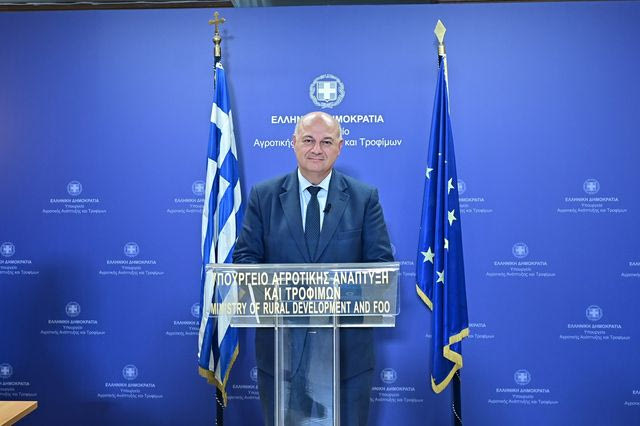
The Minister of Rural Development commented that there is room to examine possible interventions and called on farmers’ representatives to engage in “meaningful dialogue.”
- 15 Δεκεμβρίου 2025 16:53
The Minister of Rural Development, Kostas Tsiaras, officially responded to the farmers’ demands on behalf of the government. Mr. Tsiaras stated that “we are exhausting the margins of support, with the necessary sensitivity toward our farmers,” emphasizing that “some of the farmers’ demands are fair and reflect the pressures faced by the primary sector.”
“The government and the Ministry of Rural Development and Food treat the problems of the agricultural community with absolute seriousness. We always strive to exhaust the margins of support through national funds and European resources, showing the necessary sensitivity. This does not mean that there are no problems to be addressed. Some of the demands raised by farmers are fair and reflect the pressure exerted on the primary sector by production costs, international developments, and the impacts of the climate crisis. Everyone knows that the government has been in dialogue with them over recent months,” he said.
“On our side, as the Prime Minister himself has made clear, there is the will to discuss substantively all the issues concerning the agricultural community. In this context, we have carefully examined each demand, taking into account both producers’ needs and the economy’s capacity, as well as the European institutional framework. In recent months, we have satisfied a number of demands, while payments from OPEKEPE have been normalized following last summer’s problems. Throughout this period, we have been working together with the competent ministries on our farmers’ requests,” the minister added.
According to the minister, there is room to examine interventions concerning:
- Production costs, through measures that immediately reduce burdens and enhance producers’ liquidity
- Energy, by ensuring stable and lower prices for agricultural electricity
- Fuels, particularly the issue of agricultural diesel at the pump
- ELGA, with immediate changes to the regulation so that compensation covers 100% of insured damage
- Support for the most pressured sectors, such as livestock farming and specific crops. The new support will come from the utilization of unallocated funds from the CAP basic payment
As he noted, “these amounts are the result of the clean-up of OPEKEPE and targeted cross-checks by AADE.”
He concluded by calling on farmers to engage in “meaningful dialogue.” “We are calling immediately on farmers’ representatives to enter into meaningful dialogue in order to examine even more specific issues. The sooner this happens, the better—for farmers and for all other social groups. With respect for their needs, but also with awareness of the country’s real capabilities. Society expects responsibility both from the government and from farmers’ representatives,” he said.
As previously announced by government spokesperson Pavlos Marinakis, Mr. Tsiaras will accept only some of the farmers’ demands. “There are demands that are reasonable and do not derail public finances or reflect a logic of handouts,” he said, adding: “There are also maximalist demands and demands that cannot be satisfied due to EU rules.”
He outlined which demands will not be accepted, noting for example that European rules do not allow the setting of guaranteed prices—rules under which agricultural subsidies are granted. He also described as a red line the transfer of OPEKEPE to AADE.
However, he left open the possibility of re-examining the refund of the excise duty (EFK) on agricultural diesel, while expressing reservations about the demand for tax-free agricultural diesel at the pump, calling it a technical discussion that will take place if farmers come to the dialogue. He also left open the possibility of extending the electricity pricing arrangement, but at 9 cents per kilowatt-hour rather than the 7 cents requested by farmers.
“The goal is—and we have done this without waiting for the blockades—to give as much as we can to all farmers, not only those at the blockades,” the government spokesperson stated. “But always within what is reasonable and feasible. Greece paid dearly for the logic of bidding wars and cost-free promises,” he said.
The list of farmers’ demands
It is recalled that yesterday (14/12) the demands of the farmers at the blockades were announced to the government and the Prime Minister, as they were shaped following the decisions of the Panhellenic Meeting held in Nikaia.
The representatives of the blockades, after collective discussion and coordination at a nationwide level, agreed on a unified framework of demands, which includes issues of repression, income, production costs, compensation, subsidies, and institutional interventions in the agricultural and livestock sectors.
The list of demands, as communicated by the Panhellenic Committee of Blockades, is as follows:
- An end to state repression, authoritarianism, and “farmers’ courts” – expungement of all case files related to mobilizations of protesting farmers by decision of Parliament.
- Immediate payment of all outstanding amounts owed by the government.
- Minimum guaranteed prices that cover production costs and ensure a viable income to meet living needs and cultivation expenses.
- Reduction of production costs: tax-free diesel at the pump and redefinition of liters per crop; a cap on agricultural electricity prices at 7 cents/kWh and abolition of the Energy Exchange; subsidies for inputs and supplies and abolition of VAT.
- Compensation for lost income in 2025 for all products whose prices have collapsed below production cost.
- Implementation of the necessary infrastructure projects demanded by the agricultural movement in every region (e.g. irrigation, flood and fire protection works, rural road networks, etc.).
- Amendment of the ELGA regulation so that production and capital are insured and compensated at 100% against all natural risks and diseases at all stages of production, with adequate state funding.
- Linking subsidies to production in agriculture and to livestock numbers in animal husbandry. Those who produce and are genuine farmers and livestock breeders should receive the subsidies, which should be non-seizable.
- Abolition of ATAK–KAEK requirements for plots under 20 stremmas due to fragmentation and multiple ownership. Legislative establishment of land exchanges due to lack of land consolidation and fragmentation. Immediate inspections and payment of all blocked tax identification numbers (AFMs). Payment of Measure 23. Proper operation of the Monitoring system.
- An end to mass imports and “Greekization” (mislabeling as Greek) of similar products without tariffs, e.g. Mercosur and other EU agreements.
- Freezing of debts to social security funds, KEAO, tax offices, banks, PPC (DEI), and regulation of debts with interest-free installments and no down payment.
- No reduction of CAP funds for war preparations, as cuts are already being prepared.
- Abolition of the electronic delivery note issued by producers from the field.
- Immediate doubling of farmers’ pensions.
Two urgent issues are highlighted:
Foot-and-mouth disease in livestock farming: vaccination of animals, full compensation for culled animals, replacement of lost income, free reconstitution of herds. Compensation for bluetongue disease as well.
OPEKEPE scandal: return and redistribution of the stolen funds to the real beneficiaries; farmers should not pay the fines; assignment of political and criminal responsibility and publication of names. Clean-up of OPEKEPE, establishment of a control mechanism, and rejection of its transfer to AADE».