What caused the liquid cement leak that flooded Kypseli – What is “Athens Schist”
Διαβάζεται σε 3'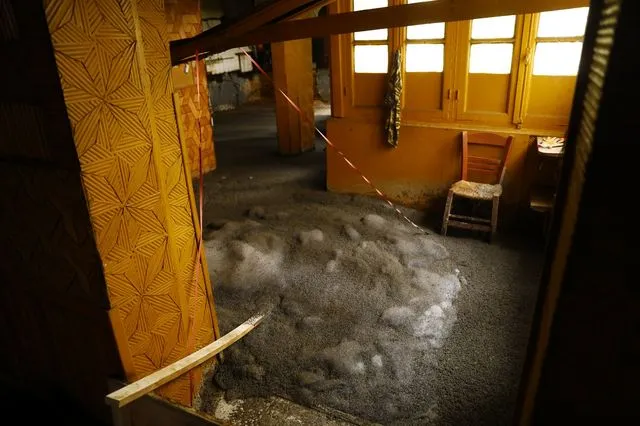
The incident involving a leak of liquid cement from the courtyard of an abandoned house in Kypseli has raised questions and caused concern.
- 16 Απριλίου 2026 11:31
A mysterious incident involving a leak of liquid cement from the courtyard of an abandoned house in the Kypseli area of Athens has sparked questions and concern among residents.
The phenomenon is now believed to be linked to construction works for Metro Line 4, which appear to have triggered the leak and led to the closure of two streets in the neighborhood.
The incident began shortly after 4 p.m. on Wednesday (15/4), when a resident noticed a thick grey liquid emerging from the gate of an abandoned property on Strofadon Street. Curious, he opened the entrance to see what was happening.
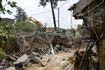
The leak continued throughout the night, eventually spreading across the entire block and covering the road surface in liquid cement. Several parked vehicles were also trapped in the area.
Due to the incident, traffic was suspended at two key points in Kypseli: on Evvias Street from the intersection with Spetson Street, and on Strofadon Street from the intersection with Skyrou Street.
Likely cause: Metro construction
Residents initially suspected the ongoing Metro construction, a theory that now appears to be confirmed. Beneath the affected streets—located between the under-construction Kypseli and Dikastiria stations—excavation works for the new metro line are underway.
According to early assessments, a technical failure may have led to the leakage, with the material finding its way to the surface through the drainage system of the abandoned building.
Reports from ERT indicate that despite timely alerts to municipal authorities, only traffic police have so far intervened to regulate traffic, while no full technical response team has arrived to stop the leak, apart from private contractors cooperating with Attiko Metro.
The “Athens Schist” explanation
On Thursday morning (16/4), technical teams and engineers arrived at the site to assess the material. Early speculation suggests it may not be cement at all, but rather “Athens Schist” (Athinaikos Schist), a geological formation found beneath the Attica basin.
The Greek Metro authority describes the Athens Schist as a complex mixture of sedimentary and metamorphic rocks—mainly flysch-type formations dating back to the Upper Cretaceous period. It includes clay-rich sandstones, siltstones, limestones, greywackes, and shale-like materials, with local volcanic intrusions that have caused significant deformation over time.
Due to its highly heterogeneous and fractured nature, the formation is notoriously difficult to predict and map accurately, making tunnel excavation particularly challenging.
Above it lie younger sedimentary layers, including river deposits, loose soils, and artificial fill from human activity over the centuries.
Geologists note that while the formation is generally of low permeability, localized fractures and voids can sometimes allow unexpected material movement—especially during large-scale underground construction projects such as the Athens Metro expansion.