Vardousia: The operation to recover the bodies is extremely difficult – Plan B
Διαβάζεται σε 5'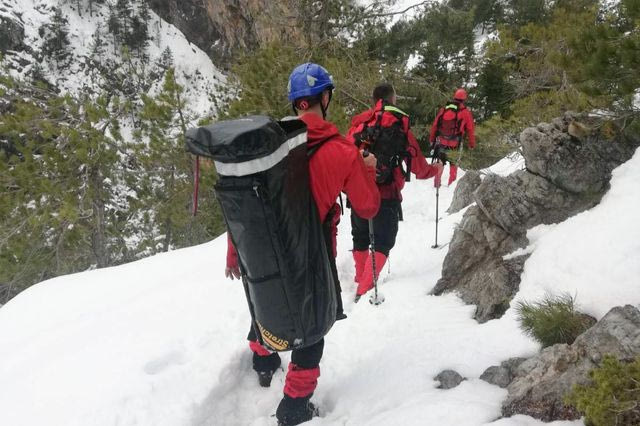
The recovery of the bodies of the mountaineers who were buried by an avalanche in the Vardousia Mountains and met a tragic death is being carried out by helicopter and special harnesses.
- 27 Δεκεμβρίου 2025 14:51
A dramatic and extremely difficult operation is currently underway to recover the bodies of the four mountaineers who were found dead in the Vardousia Mountains after being struck by an avalanche. A large force of the Fire Service and volunteer teams is operating in the area, with the aim of completing the procedure before nightfall.
According to the latest information from Orange Press, one of the bodies has already been retrieved by the Super Puma helicopter participating in the operation and is expected to be transferred to the hospital in Itea and possibly later to Rio for an autopsy. For the remaining three unfortunate mountaineers, efforts are being made to move them to a flat area so that hoisting with a winch can be carried out.
“At 2,000 meters—mountain mass with snow and a steep slope”
Haris Asargiotakis, a member of the Hellenic Rescue Team of Attica who is taking part in the operation, describes the conditions on the ground. The forces have been divided, with the base team positioned lower down, while special units are operating at the inaccessible site of the tragedy.
“We are at the base of the operation… I am lower down, at around 1,700–1,800 meters where there is no snow. This incident is around 2,000 meters, where there is snow,” Mr. Asargiotakis says, describing the landscape as a mountain mass with rocks and a steep slope.
At the site there are four EMAK teams, mountain guides, and volunteer groups, with EMAK members having climbed higher to prepare the victims for air evacuation.
The timetable and the ‘Plan B’
Rescuers’ anxiety is peaking as time presses on. As Mr. Asargiotakis explains, there is a ready alternative plan in case the helicopter cannot complete the mission—something that would, however, mean significant delays.
“If the helicopter can’t manage it, transport will be done by hand, which means at least two hours of walking… So for the descent we will need a similar amount of time,” he says. He expresses hope that the process can be completed by air “so we don’t delay; otherwise, night will catch us.”
An ally in the operation is the weather, which—unlike previous hours—is clear and without winds, facilitating the work of the aircraft.
The three factors that led to the tragedy
Regarding the initial findings of the case, the difficult conditions in the area, and the large search operation, Kostas Tsigas, president of the Union of Fire Service Officers, spoke publicly.
As Mr. Tsigas said on the program “Weekend from 5,” the four mountaineers set out on Christmas Day for a climb in the Korakas area, along the ridge of the Vardousia Mountains.
“Four of our fellow citizens set out for mountaineering in the Vardousia area. According to testimonies from locals and the first findings of the investigation, it appears they became disoriented,” Mr. Tsigas noted.
As he explained, the altitude, the rugged terrain of the area, and the weather conditions likely played a decisive role in the tragedy. “The conditions due to altitude and intense relief may have forced them to lose their orientation,” he said.
“Visibility was very low, there was a lot of snow, and possibly a snowstorm affected the route they followed,” the president of the Union of Fire Service Officers emphasized.
According to him, fresh snow and strong winds may have shifted large quantities of snow. “Some wind may have driven a large volume of snow to the point where they were eventually found,” he added. Regarding whether they were experienced mountaineers, he noted that some had reached the summit in the past; however, the snowfall had made it very difficult to find the trails.
The timeline
The group of four, including one man from the village of Athanasios Diakos, set out on Christmas morning from the village of Athanasios Diakos with the destination of Korakas peak.
During their route, they appear to have encountered a snowstorm, and shortly afterward the signal from their mobile phones was lost, making any communication impossible. Concern among relatives and friends intensified when attempts to contact them proved unsuccessful.
Initial searches on Christmas Day were carried out by village residents, who found nothing. At 9 p.m. the same day, the police were notified and rescue forces were immediately mobilized. From that moment, an extensive search operation was set up, lasting nearly 24 hours, on one of the most demanding and dangerous mountains in the country.
For the search, 30 firefighters were mobilized with the Mountaineering Teams of the 1st, 6th, 7th, and 8th EMAK units, a special tracked vehicle, Thessaly’s drone team, and a helicopter. Mountain guides from the Hellenic Mountaineering and Climbing Federation, volunteers, and local residents also participated.
Their vehicle was located on Thursday (25/12) by the forces involved in the searches; however, no trace was found that led to the discovery of the mountaineers themselves.
Weather conditions in the area—low temperatures, strong winds, and dense snow—significantly hampered the rescuers’ work.
Despite the superhuman efforts of the rescue crews, the four were located at an extremely inaccessible point, with reports indicating a particularly difficult recovery.
It is noted that the Vardousia area is a particularly demanding mountaineering destination which, in winter, does not forgive mistakes—even by the most experienced.